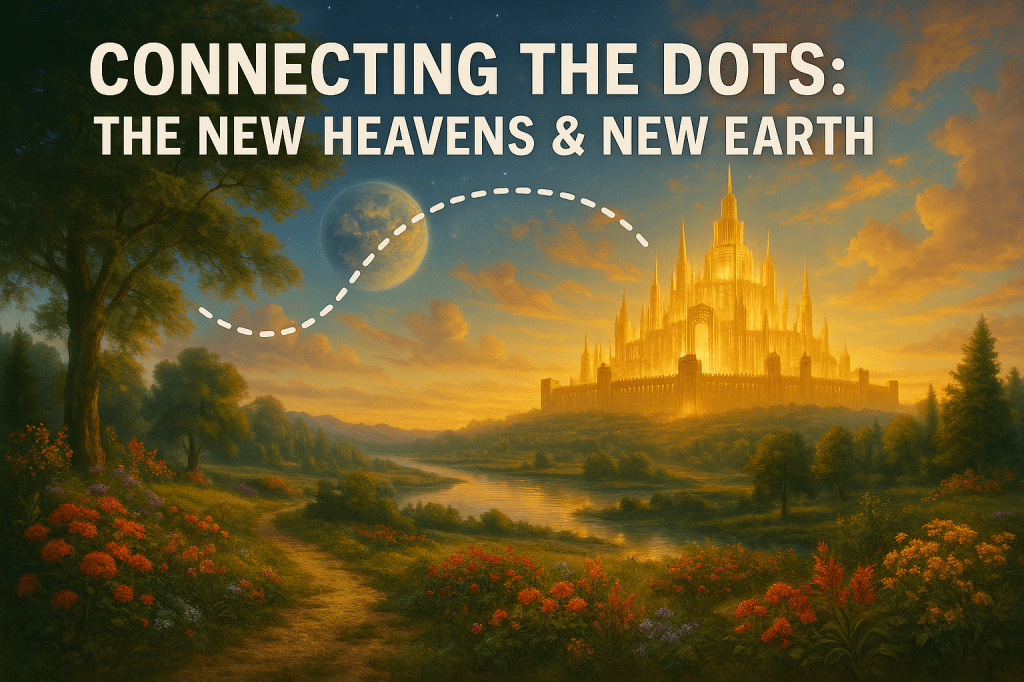
We’ve reached the final post in the “Connecting the Dots” series as we conclude with the New Heavens and New Earth, the culmination of God’s redemptive plan. This doctrine anchors our hope, revealing a restored creation where God dwells with His people forever, free from sin’s curse. Like Adam and Eve’s fellowship with God in Eden, we’ll experience His presence fully, a promise that shapes how we live today.
Revelation 21:1-5 unveils this promise: “Then I saw a new heaven and a new earth, for the first heaven and the first earth had passed away, and the sea was no more. And I saw the holy city, new Jerusalem, coming down out of heaven from God, prepared as a bride adorned for her husband. And I heard a loud voice from the throne saying, “Behold, the dwelling place of God is with man. He will dwell with them, and they will be his people, and God himself will be with them as their God. He will wipe away every tear from their eyes, and death shall be no more, neither shall there be mourning, nor crying, nor pain anymore, for the former things have passed away.” And he who was seated on the throne said, “Behold, I am making all things new.” Also he said, “Write this down, for these words are trustworthy and true.”
After Christ’s return, the Great White Throne Judgment, and Satan’s defeat, God renews all things. This New Creation fulfills His promises, restoring what was lost in the Fall. Let’s explore seven truths about the New Heavens and New Earth and how they call us to live now.
Seven Truths About the New Heavens and New Earth
1. Creation Will Be Renewed, Not Destroyed
Revelation 21:1 states, “The first heaven and the first earth had passed away.” The Greek word “kaine” for “new” means transformed in character, not annihilated. Isaiah 65:17 prophesies, “I create new heavens and a new earth, and the former things shall not be remembered.” Romans 8:19-22 describes creation, groaning under sin’s curse, being “set free from its bondage to corruption.” Just as God transforms our hearts without destroying us (2 Corinthians 5:17), He will renew creation, restoring it to Eden’s perfection, free from sin’s decay.
2. God Will Dwell with His People Forever
Revelation 21:3 declares, “The dwelling place of God is with man. He will dwell with them, and they will be his people.” This echoes Eden’s fellowship, disrupted by the Fall. In the Old Testament, God’s presence was in the tabernacle; in the New Testament, the Holy Spirit indwells believers. In the New Creation, we’ll see God face-to-face. 1 John 3:2 promises, “When he appears we shall be like him, because we shall see him as he is.” Jesus’ beatitude, “Blessed are the pure in heart, for they shall see God” (Matthew 5:8), finds fulfillment here, in perfect communion with our Creator.
3. All Negative Aspects Will Cease
Revelation 21-22 lists what will vanish: sea (symbolizing chaos), separation, death, mourning, weeping, pain, night, sin, evil, hunger, thirst, and the curse. Everything contrary to God’s character or harmful to His people will be eradicated. Loneliness, grief, and sin’s weight will be gone, replaced by eternal joy. This promise assures us that our present struggles are temporary, giving us hope for a perfect future.
4. God’s Faithfulness Guarantees Its Reality
Revelation 21:5-6 proclaims, “Behold, I am making all things new… these words are trustworthy and true… It is done!” God’s track record—delivering the promised seed (Jesus), Isaac to Abraham, the resurrection, and the Spirit at Pentecost—proves His faithfulness. If God says it, He will do it. This certainty anchors our confidence in the New Creation’s reality.
5. The Faithless Will Not Enter
Revelation 21:8 warns, “But as for the cowardly, the faithless, the detestable… their portion will be in the lake that burns with fire.” Only those who trust in Christ enter the New Jerusalem. Rejecting Jesus, whether through pride or self-reliance, leads to eternal judgment. This sobering truth urges us to cling to Christ’s finished work, the only path to salvation.
6. Renewal Reflects God’s Commitment to Creation
Scripture’s story isn’t about escaping the world but redeeming it. God loves His creation, and the New Heavens and New Earth fulfill His plan to restore it. The creation mandate—to subdue and keep the earth (Genesis 1:28)—remains true. How we work, spend, create, or play matters to God. John Piper said, “Whatever we love rightly in this world will either be perfected and preserved, or will be taken from us only in the sense that something will be given that is so much better, as to make the thing we hoped never to lose as nothing by comparison.” Sports, work, or relationships may continue, transformed, reflecting God’s commitment to His world.
7. Our Future Shapes Our Present
Belief in the New Creation shapes our lives now. 2 Corinthians 4:16-18 encourages, “We do not lose heart… For this light momentary affliction is preparing for us an eternal weight of glory.” Our eternal perspective determines our response to trials. Are we crushed or hopeful? Despairing or confident? Fearful or joyful? A life focused on eternity trusts God, rejects fleeting sins, and pursues His glory. Revelation 21:9-27’s vision of the New Jerusalem—radiant with God’s presence—fuels this hope.
Living in Light of the New Creation
These truths call us to live with an eternal perspective:
1. Trust God’s Promises
God’s faithfulness ensures the New Heavens and New Earth. When afflicted, trust His promise of restoration. Repent of doubts and lean on His trustworthy word, confident that He will fulfill what He has spoken.
2. Steward Creation Well
Since God will renew creation, we steward it now. Work diligently, use resources wisely, and enjoy God’s gifts—art, sports, relationships—as acts of worship. Live out the creation mandate, cultivating the world for His glory.
3. Live with Eternal Hope
Examine your life: does it reflect eternity? Repent of seeking temporary pleasures that dishonor God. Colossians 3:2 urges, “Set your minds on things that are above.” Face trials with joy, knowing they prepare you for glory. Share the gospel urgently, pointing others to Christ, the only way to the New Creation.
Our Eternal Home
The New Heavens and New Earth fulfill God’s redemptive story, restoring creation and humanity to Eden’s perfection. We’ll dwell with God, free from sin and sorrow, in a renewed world. As we live with this in mind, let’s trust His promises, steward His creation, and live with hope, praying, “Come, Lord Jesus!” (Revelation 22:20). Our future with Him shapes our lives today.



 Tethered to Truth