Why is Christianity so Exclusive?

This is the first post in a series of apologetics questions I will be answering to help equip you in defending the faith. I’m going to begin by tackling the question: Why is Christianity so exclusive? Drawing from John 14:6, where Jesus declares, “I am the way, and the truth, and the life. No one comes to the Father except through Me,” we explore the bold claim that sets Christianity apart from every other religion. This statement, as radical today as it was in Jesus’ time, carries eternal implications for every person. As G.K. Chesterton noted, “Right is right, even if nobody does it. Wrong is wrong, even if everybody is wrong about it.” Truth remains true, regardless of popular opinion.

Consider the flat earth belief in ancient times. Around 500 B.C., Pythagoras proposed the earth was a sphere, a view ridiculed until proven centuries later. Truth didn’t depend on majority acceptance; it was true nonetheless. Similarly, Jesus’ claim in John 14:6 stands firm, asserting He is the sole path to God. Let’s unpack what He means by “the way, the truth, and the life.”

The Way: Jesus is the exclusive path to the Father. 1 Timothy 2:5 states, “There is one God, and there is one mediator between God and men, the man Christ Jesus.” Hebrews 10 calls Him “the new and living way,” tearing the curtain separating us from God. In John 10, He is “the door” to salvation. No other figure—religious or otherwise—offers access to the Father. Jesus alone provides a way for us to be in relationship with the Creator.

The Truth: Jesus embodies truth. John 1:17-18 explains that “grace and truth came through Jesus Christ,” revealing the unseen God. 1 John 5:20 adds that Jesus gives understanding to know the true God. As the standard of righteousness, He testifies to God’s reality, countering all false claims about divinity.

The Life: Jesus possesses life inherently and grants it to His followers. In John 11:25-26, He says, “I am the resurrection and the life. Whoever believes in me, though he die, yet shall he live.” In John 6:35, He is “the bread of life,” satisfying our deepest desires. Only through Him do we find eternal life and true fulfillment.

Jesus’ claim, “No one comes to the Father except through me,” leaves no middle ground. As C.S. Lewis famously argued, Jesus is either a liar, a lunatic, or Lord. If true, His words demand our allegiance; if false, He’s a complete fraud and should be rejected. He further clarifies in John 14:7 that knowing Him is knowing the Father, as He is “the image of the invisible God” (Colossians 1:15), fully divine and equal with the Father.

This claim to exclusivity invites objections, three of which I’ll address below:

  1. Aren’t all religions the same?
    No, they aren’t. Religions contradict on core issues: one God versus many, the existence of hell, or the authority of Scripture. For example, Christianity’s claim of Jesus as the only way conflicts with other faiths’ teachings. Cults like the Branch Davidians or Brazil’s Sunrise Valley, with its alien beliefs, highlight the absurdity of equating all religions. Christianity uniquely teaches that salvation comes not through human goodness but through Jesus’ sacrifice, as no one can earn heaven (Romans 3:23). If other paths sufficed, Jesus’ death would be meaningless. When faced with this objection, gently show that contradictory truth claims cannot all be true and point to Jesus as the only atonement for sin.
  2. Isn’t truth relative?
    Relativism claims truth varies by individual, but this self-destructs. Saying “truth is relative” is itself an objective claim, contradicting its premise. Michael Kruger calls relativism “pride masquerading as humility.” If you believe you’re a bird and jump off a building, reality—namely gravity—prevails. Jesus either rose from the dead or didn’t; our beliefs don’t change His reality. We must respond to relativism by highlighting its self-contradiction and affirming Scripture as the ultimate authority.
  3. Isn’t claiming exclusivity arrogant?
    Christians are often labeled arrogant for believing Jesus is the only way. Yet, this claim originates with Jesus, not us. Acts 4:12 declares, “There is salvation in no one else.” Christianity isn’t man’s attempt to reach God but God’s revelation to man through Jesus. When accused of arrogance, point to Jesus’ words and encourage others to investigate His life in Scripture. Let them wrestle with His claims, not yours.

Jesus’ exclusivity is proven by His perfect life, death, and resurrection. He bore our sins on the cross, offering what no other religion can: atonement. John 8:31-32 promises, “If you abide in my word, you are truly my disciples, and you will know the truth, and the truth will set you free.” Are you abiding in Him, submitting to His truth over culture’s lies? Repent, believe in Jesus—the way, the truth, and the life—and find freedom in the only One who leads to the Father.

False Religions: Islam

Islam is the world’s second-largest religion with over 2 billion adherents, primarily in the Asia-Pacific and Middle East/North Africa regions. While Islam shares superficial similarities with Christianity and Judaism—such as monotheism and reverence for figures like Abraham—it fundamentally contradicts the gospel. This article explores Islam’s origins, core beliefs, contrasts with Christianity, and strategies for lovingly sharing the true gospel with Muslims, grounded in Scripture’s authority.

Historical Context and Foundation

Islam arose in the 7th century on the Arabian Peninsula, a region steeped in tribalism, polytheism, and emerging monotheistic influences. Mecca, a commercial and religious hub, housed the Kaaba, a shrine with idols worshipped by polytheistic tribes. The Quraysh tribe, custodians of the Kaaba, held significant influence. Jewish tribes in Medina and non-orthodox “Christian” groups (e.g., Nestorians) introduced distorted monotheistic ideas, shaping the religious landscape.

Muhammad’s Life and Revelations

Muhammad ibn Abdullah (c. 570–632 CE), Islam’s founder, was born in Mecca, orphaned, and raised by his uncle, Abu Talib. Known as “Al-Amin” (the trustworthy), he married Khadija, a wealthy widow with Ebionite Christian ties, at age 25. Scholars suggest Muhammad’s exposure to skewed biblical accounts came through his uncle’s trade travels and Khadija’s influence. Around 610 CE, at age 40, Muhammad claimed revelations from the angel Gabriel in a cave on Mount Hira, declaring him Allah’s messenger. These revelations, received over 23 years, form the Qur’an, which Muslims believe is Allah’s eternal, error-free word.

Muhammad initially preached privately, gaining followers like Khadija, his cousin Ali, and friend Abu Bakr. His public call to monotheism and rejection of idolatry angered the Quraysh, who feared economic loss from Kaaba pilgrimages. Persecution led to the Hijrah in 622 CE, when Muhammad fled to Medina, marking the Islamic calendar’s start. In Medina, he built a theocratic community, engaged in military campaigns, and married multiple wives, including Aisha at age 6 (consummated at 9). By 630 CE, he conquered Mecca, rededicating the Kaaba to Allah. After his death in 632 CE, Abu Bakr became the first caliph, and Islam spread rapidly through conquests across the Middle East, North Africa, and Persia.

Key Texts and Authority

The Qur’an, with 114 surahs, is Islam’s central scripture, considered divine in Arabic. The Hadith (Muhammad’s sayings) and Sunnah (his practices) guide theology and Sharia law. Sunni (85–90%) and Shia (10–15%) Muslims differ over leadership succession, with Sunnis accepting the first four caliphs and Shiites revering Ali and his descendants. Other groups, like Sufis (mystics) and Ahmadis, face varying acceptance.

Major Islamic Beliefs and Christian Contrasts

Islam’s theology rests on the Six Articles of Faith (theological convictions) and Five Pillars (practical duties), which differ starkly from biblical Christianity.

Six Articles of Faith

  1. Oneness of God (Tawhid): Allah is one, transcendent, and indivisible, rejecting the Trinity as shirk (Qur’an 4:48; 5:73).
  2. Angels: Angels like Gabriel serve Allah, recording human deeds for judgment.
  3. Divine Books: Allah sent the Torah, Psalms, Gospel, and Qur’an, but earlier scriptures are deemed corrupted, with the Qur’an as final (Qur’an 3:3-4).
  4. Prophets: Adam, Noah, Abraham, Moses, Jesus, and Muhammad are prophets, with Muhammad as the final “Seal” (Qur’an 33:40).
  5. Day of Judgment: Deeds determine paradise or hell, with Allah’s mercy pivotal but salvation uncertain.
  6. Divine Decree (Qadar): Allah’s will governs all, though humans have free will.

Five Pillars of Islam

  1. Shahada (Declaration of Faith): Declaring, “There is no god but Allah, and Muhammad is his messenger.” This is the entry point into Islam.
  2. Salat (Prayer): Five daily prayers facing the Kaaba. Prayers involve specific postures and recitations in Arabic.
  3. Zakat (Giving): Giving 2.5% of wealth annually to support the community.  This supports needs of community, relief of poverty, upkeep of meeting places, and spread of faith.
  4. Sawm (Fasting): Fasting during Ramadan from dawn to dusk, abstaining from food, drink, and sexual activities, to cultivate spiritual discipline and empathy.
  5. Hajj (Pilgrimage): Those physically and financially able must perform the pilgrimage to Mecca, reenacting rituals tied to Abraham and Muhammad, at least once in their lifetime.

Contrasts with Christianity

Nature of God: Islam emphasizes Allah’s absolute oneness and transcendence, rejecting the Trinity.

  • Christian Difference: Teaches one God in three persons (Father, Son, Holy Spirit), emphasizing God’s relational nature.

Person and Work of Jesus Christ: Islam views Jesus (Isa) as a revered prophet, denying his divinity and crucifixion. 

  • Christian Difference: Affirms Jesus as fully God and fully man, whose death and resurrection atone for sin and secure salvation.

Salvation: Islam teaches salvation hinges on faith in Allah, good deeds, and Allah’s mercy, with no assurance. 

  • Christian Difference: Teaches salvation by grace through faith in Christ alone, providing assurance of eternal life.

Scripture: Islam considers the Qur’an the final, infallible revelation, superseding a supposedly corrupted Bible. 

  • Christian Difference : Affirms the Bible as the inspired, inerrant Word of God, consistent in revealing God’s redemptive plan.

Prophethood and Revelation: Islam asserts Muhammad as the final prophet. 

  • Christian Difference: Sees Jesus as the final and ultimate revelation.

View of Sin: Islam views sin as disobedience, with humans born pure and no concept of original sin. 

  • Christian Difference: States all are born sinful due to Adam’s fall, necessitating a Savior.

Jihad: Jihad means “struggle” or “striving.” Debate in meaning internal or external fighting.

  • Christian Difference: Spiritual struggle resisting sin and the devil (Eph. 6:12). Rejects violence for spreading faith.

Engaging and Evangelizing Muslims

Sharing the gospel with Muslims requires love, respect, and reliance on the Holy Spirit, who convicts and converts (John 16:8). Here are biblical strategies:

  1. Build Relationships: Muslims value hospitality. Share meals, respect practices (e.g., avoiding pork), and ask about their faith to build trust (Colossians 4:5–6). Women should engage women due to cultural norms.
  2. Find Common Ground: Acknowledge shared figures like Abraham or Jesus, then clarify differences. Use John 1:1–14 or Colossians 1:15–17 to affirm Jesus’ deity. Show Jesus’ divine claims (John 8:58; 10:30) to challenge his mere prophethood.
  3. Present the Gospel: Explain sin’s separation (Romans 3:23; Isaiah 64:6), Christ’s atoning death (Romans 5:8), and salvation’s assurance (John 5:24). Contrast Islam’s uncertain mercy with God’s immanence and love (Isaiah 55:8; 1 John 3:1).
  4. Address Objections: For the Trinity, use Genesis 1:26 and Matthew 28:19. For the Bible’s reliability, highlight its manuscript evidence versus the Qur’an’s later standardization. Avoid attacking Muhammad directly to maintain dialogue.
  5. Encourage Bible Reading: Suggest John or Romans to reveal Christ’s truth. Offer a Bible in their language.
  6. Invite to Community: Welcome Muslims to church or Bible studies to experience Christian fellowship (Acts 16:14).
  7. Pray: Seek the Spirit’s guidance, trusting God for conversions (Romans 9:16).

Conclusion

Islam’s teachings on God, Jesus, salvation, and scripture diverge from biblical Christianity, making it a counterfeit faith. We must always engage Muslims with love, sharing the gospel of grace through faith in Christ, the eternal Son of God. Trust the Holy Spirit to work, boldly proclaiming the only truth that saves.

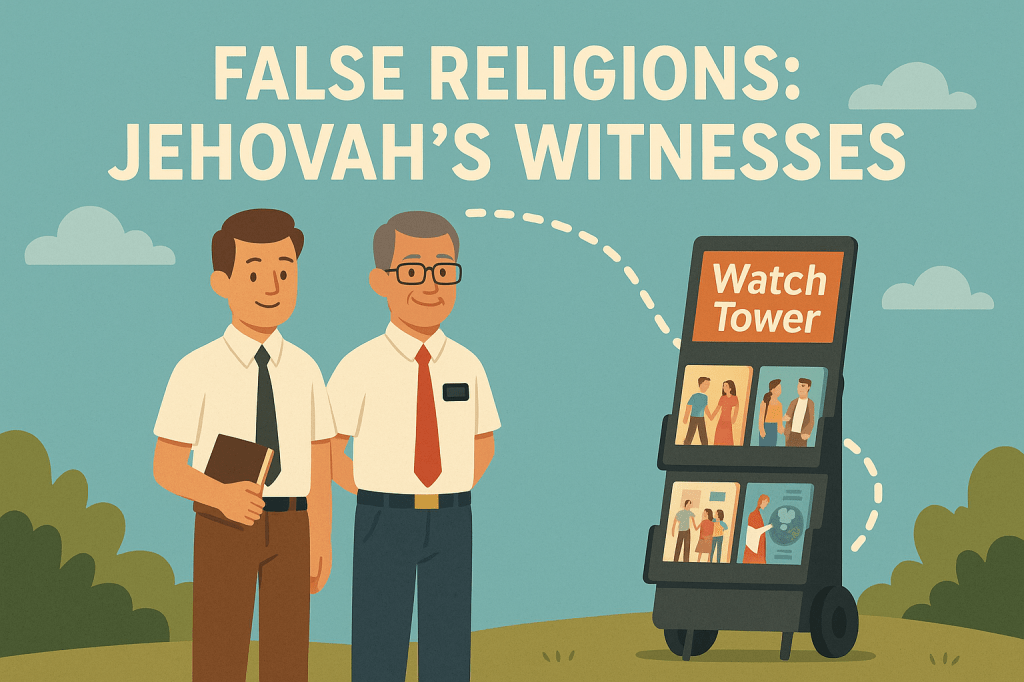
False Religions: Jehovah’s Witnesses

Introduction

Jehovah’s Witnesses, with over 9 million members worldwide, represent one of the largest and most distinctive religious cults due to their centralized authority and strict social practices. Founded in the late 19th century, their movement is rooted in a questionable interpretation of the Bible, emphasizing door-to-door evangelism and an apocalyptic worldview. This article explores the origins of Jehovah’s Witnesses, their core beliefs, how they differ from orthodox Christianity, and strategies for engaging them in meaningful dialogue using Scripture.

Foundation and Historical Context

The Jehovah’s Witnesses movement began in the 1870s under Charles Taze Russell, a Pittsburgh native who rejected his Presbyterian upbringing as a teenager, questioning traditional Christian doctrines such as the Trinity and eternal punishment. At 18, Russell started a Bible study group known as the Bible Students, where he developed and shared his theological views. In 1879, he launched Zion’s Watch Tower and Herald of Christ’s Presence, a magazine that became a primary vehicle for disseminating his teachings. In 1884, he established the Watch Tower Bible and Tract Society, formalizing his movement. Initially called “Russelites,” his followers adopted the name “Jehovah’s Witnesses” in 1931 under the leadership of Joseph Franklin Rutherford, who succeeded Russell after his death in 1916. Rutherford centralized authority and distinguished the group from other Bible Student factions.

Russell’s theology was heavily influenced by the Adventist movement, particularly its focus on Christ’s imminent return. He made several failed predictions about the Second Coming, including dates in the 1870s and 1914, which later evolved into the belief that Christ returned invisibly to establish God’s Kingdom. The organization, now governed by a small group known as the Governing Body, relocated its headquarters from Brooklyn to Warwick, New York, in 2016. This central authority enforces doctrinal uniformity and directs global evangelistic efforts, a hallmark of the Witnesses’ identity.

Core Beliefs of Jehovah’s Witnesses

Jehovah’s Witnesses hold a distinct set of beliefs, primarily based on their New World Translation (NWT) of the Bible, first published in 1950. Below is an overview of their major theological positions and how they contrast with orthodox Christianity.

Monotheism and Rejection of the Trinity

Jehovah’s Witnesses are strict monotheists, believing Jehovah is the sole true God, rejecting the Christian doctrine of the Trinity. They view Jesus as a created being—specifically the archangel Michael—and the Holy Spirit as an impersonal “active force” akin to energy, not a divine person. This is supported by their interpretation of passages like Acts 2:4, where the Spirit “fills” believers.

Christian Difference: Orthodox Christianity affirms the Trinity: one God in three coequal, coeternal persons (Father, Son, Holy Spirit), as seen in Matthew 28:19 and 2 Corinthians 13:14. Scriptures like John 1:1 (“the Word was God”) and Colossians 2:9 (“in Christ all the fullness of the deity dwells bodily”) confirm Jesus’ divinity, while Acts 13:2 and Romans 8:26 portray the Holy Spirit as a person with attributes like speaking and interceding, contradicting the Witnesses’ view.

Jesus Christ

Witnesses teach that Jesus is not God but the created archangel Michael, who became human and, after his death, resumed his angelic identity as a spirit being. They assert Jesus died on a “torture stake” (a single pole), not a cross, citing the Greek term stauros (Matthew 27:32) and rejecting the cross as a pagan symbol. They also believe Jesus’ resurrection was spiritual, not physical, with his body either dissolved or preserved by Jehovah.

Christian Difference: Christianity upholds Jesus as fully God and fully man, eternally existent (John 1:1; Hebrews 1:8). Historical and biblical evidence supports crucifixion on a cross, a common Roman practice, as described in early Christian writings and John 20:27 (Thomas touching Jesus’ wounds). Luke 24:39 confirms Jesus’ physical resurrection, as he declares, “for a spirit does not have flesh and bones as you see that I have.”

Salvation

Salvation for Witnesses requires faith in Jehovah, strict adherence to Watch Tower teachings, and active participation in door-to-door evangelism. They believe only 144,000 “anointed” Witnesses will rule in heaven with Christ (Revelation 7:4), while the “great crowd” will live eternally on paradise earth (Revelation 7:9).

Christian Difference: Christianity teaches salvation by grace through faith alone (Ephesians 2:8-9; Romans 3:28), with Christ’s sacrifice sufficient for all believers (Hebrews 10:14). The Bible describes an uncountable multitude in heaven (Revelation 7:9), not a limited 144,000, and salvation is not contingent on works or organizational loyalty.

Eschatology

Witnesses anticipate an imminent Armageddon, where only faithful Witnesses will survive, and non-believers face annihilation, not eternal torment. The dead remain unconscious until a future resurrection, with the righteous living on earth or, for the 144,000, in heaven.

Christian Difference: Christianity teaches eternal life for believers and eternal punishment for the unrighteous (Matthew 25:46). Passages like Luke 16:23 and Mark 9:43-48 describe conscious torment, contradicting annihilationism. Luke 23:43 and Philippians 1:23 affirm immediate presence with God after death, not soul sleep.

Scripture

Witnesses use the New World Translation, which has been criticized for alterations supporting their theology, such as rendering John 1:1 as “the Word was a god” and inserting “Jehovah” into the New Testament. The Governing Body’s interpretations are binding, elevating their authority above Scripture.

Christian Difference: Christianity adheres to sola scriptura, with Scripture as the sole infallible authority (2 Timothy 3:16-17). Believers are encouraged to test teachings against original manuscripts (Acts 17:11), unlike the Witnesses’ reliance on the Governing Body.

Practices

Witnesses worship in Kingdom Halls, emphasizing structured Bible study and evangelism training. Door-to-door preaching is mandatory, tied to salvation. Disfellowshipping and shunning enforce conformity, even among family. They refuse blood transfusions (Acts 15:29), abstain from political involvement, and discourage higher education.

Christian Difference: Christian worship includes preaching, sacraments, and community (Colossians 3:16). Evangelism is expected but not a salvation requirement (Matthew 28:19-20). Church discipline aims for restoration (Galatians 6:1), and medical decisions, including transfusions, are matters of conscience. Christians engage in civic life (Romans 13:1-7) and value education (Proverbs 4:7).

Engaging Jehovah’s Witnesses with Scripture

Engaging Witnesses requires a thoughtful, respectful approach, as they are trained to defend their beliefs and may fear questioning due to shunning. Here are strategies and key Scriptures to use, preferably from the New World Translation (accessible at JW.org) to align with their framework:

  1. Build Trust: Show kindness and respect (1 Peter 3:15), acknowledging their dedication while gently challenging beliefs.
  2. Ask Questions: Encourage critical thinking with questions (Proverbs 18:17).
  3. Use Their Bible: Use the NWT when possible because they do not trust any outside sources.
  4. Focus on Key Issues:
    • Deity of Christ: Use Psalm 102:25-27 (NWT) to establish Jehovah’s eternality, then Hebrews 1:10-12 (NWT), which applies the same text to Jesus. Isaiah 9:6 and 10:21 use “Mighty God” for both Jesus and Jehovah. John 20:28 and Revelation 1:7-8 further affirm Jesus’ divinity.
    • Salvation by Grace: Highlight Ephesians 2:8-9 and Romans 5:1, asking why salvation depends on works.
    • The Trinity: Point to Matthew 28:19 and 2 Corinthians 13:14 for equality among Father, Son, and Holy Spirit.
    • Eternal Judgment: Use Matthew 25:46 and Revelation 20:10 to challenge annihilationism.
    • Scriptural Authority: Cite 2 Timothy 3:16-17 and Acts 17:11 to question the Governing Body’s supremacy.
  5. Be Patient & Follow Up: Conversions may take time due to indoctrination and fear of shunning (2 Timothy 2:24-25).
  6. Pray: Seek the Holy Spirit’s guidance to open their hearts (John 16:8).

Conclusion

Jehovah’s Witnesses are a dedicated group with a distinct theological framework that sets them apart from orthodox Christianity. Their origins in Russell’s rejection of traditional doctrines and their reliance on the Watch Tower Society shape their beliefs and practices. While their commitment to evangelism and moral living is notable, their teachings on the Trinity, salvation, and Scripture diverge significantly from biblical Christianity.

Engaging them requires patience, respect, and a strategic use of Scripture to point them toward the gospel of grace. By understanding their beliefs and approaching them with love, Christians can foster meaningful conversations that encourage Witnesses to reconsider their faith in light of biblical truth.

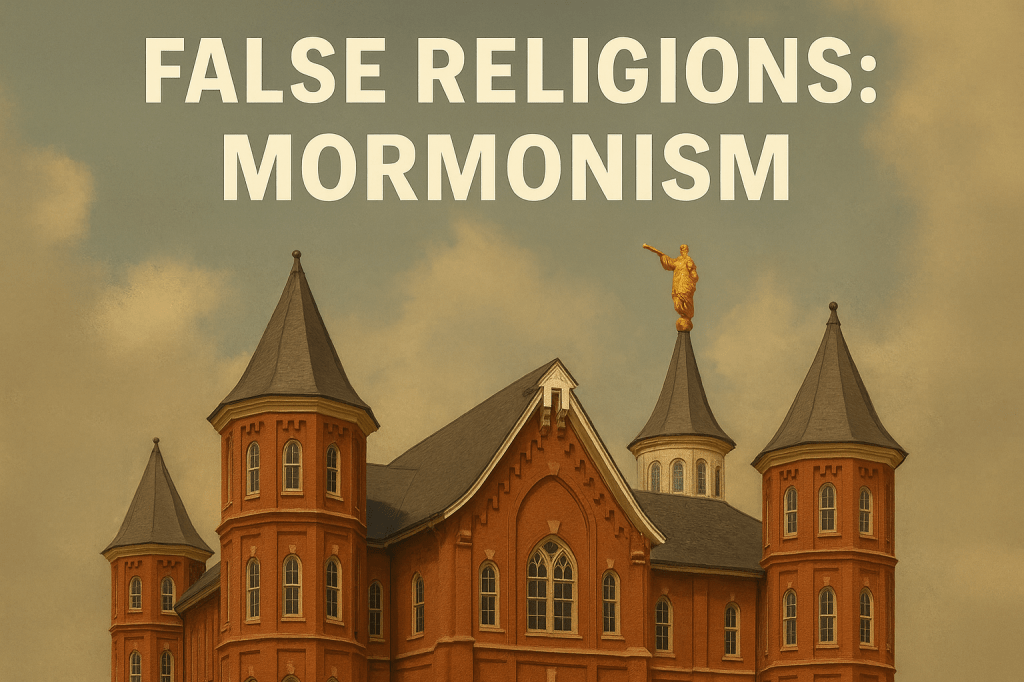
False Religions: Mormonism

Over the next few weeks we’re going to examine belief systems that deviate from biblical Christianity, starting with the Church of Jesus Christ of Latter-day Saints (LDS), commonly known as Mormonism. With over 17 million members worldwide as of 2024, the LDS Church is one of the largest religious cults globally. While Mormons use Christian language, their core doctrines fundamentally contradict biblical truth. This article explores Mormonism’s origins, key beliefs, and how Christians can lovingly engage Mormons with the gospel, grounded in Scripture’s authority.

Historical Context and Foundation

Mormonism emerged during the Second Great Awakening in the early 1800s, a time of religious fervor in America when many sought the “true” church amid competing denominations. Joseph Smith Jr. (1805–1844) founded the Church of Christ, later renamed the Church of Jesus Christ of Latter-day Saints, on April 6, 1830, in Fayette, New York.

At age 14, Smith claimed a “First Vision” in 1820, where God the Father and Jesus Christ allegedly appeared, declaring all churches corrupt. In 1823, an angel named Moroni supposedly guided him to golden plates buried near Palmyra, New York, written in “Reformed Egyptian.” Using seer stones, Smith translated these plates into the Book of Mormon, published in 1830, which Mormons consider scripture alongside the Bible. Smith also claimed John the Baptist ordained him to restore the “true” church.

The early LDS Church faced persecution for beliefs like polygamy (practiced until 1890), leading to migrations to Ohio, Missouri, and Illinois. In 1844, Smith was killed by a mob in Illinois after arrests for treason and polygamy. Brigham Young led most Mormons to Utah, establishing Salt Lake City as their headquarters.

From a Christian perspective, Mormonism’s origins are problematic. Smith’s visions and the Book of Mormon lack historical or archaeological support, and his claim of restoring a “lost” gospel contradicts the Bible’s sufficiency (2 Timothy 3:16-17; Hebrews 1:1-2). Deuteronomy 18:20-22 labels prophets with unfulfilled predictions, like Smith’s failed prophecies about Jesus’ return by 1891 or a Missouri temple, as false.

Major Mormon Beliefs and Christian Contrasts

Mormon theology blends Christian terms with unique doctrines from Smith’s revelations, diverging significantly from biblical Christianity. Below are key beliefs and their contrasts with Christian doctrine:

The Nature of God

Mormon Belief: The Godhead comprises three separate beings—God the Father, Jesus Christ, and the Holy Ghost—united in purpose but not essence. God the Father was once a mortal man who progressed to godhood, as Joseph Smith stated: “God himself was once as we are now and is an exalted man.” Humans are His literal spirit children, with potential to become gods.

Christian Difference: The Bible teaches the Trinity—one God in three persons, co-equal and co-eternal (Deuteronomy 6:4; Matthew 28:19; 2 Corinthians 13:14). God is eternal, not a former mortal (Psalm 90:2; Isaiah 43:10). Mormonism’s view introduces polytheism, contradicting God’s unique sovereignty.

Salvation

Mormon Belief: Salvation involves faith, repentance, baptism, receiving the Holy Ghost, and enduring in obedience. “Exaltation” to the Celestial Kingdom, the highest heaven, requires works and temple ordinances (2 Nephi 25:23: “It is by grace that we are saved, after all we can do”).

Christian Difference: Salvation is by grace through faith alone (Ephesians 2:8-9; Romans 3:23-24). Works result from salvation, not earn it (Titus 3:5). Mormonism’s works-based exaltation undermines Christ’s sufficient atonement.

Scripture and Revelation

Mormon Belief: Mormons accept four scriptures: the Bible (King James Version, “insofar as it is translated correctly”), Book of Mormon, Doctrine and Covenants, and Pearl of Great Price. The Book of Mormon recounts Jews (Nephites and Lamanites) in ancient America, with Jesus appearing there. Ongoing revelation through LDS presidents continues to shape doctrine.

Christian Difference: The Bible is the sole, sufficient Word of God (2 Timothy 3:16-17; Hebrews 1:1-2). The canon is closed, and new scriptures or prophets contradict its finality (Revelation 22:18-19). The Book of Mormon lacks historical or archaeological evidence.

Jesus Christ

Mormon Belief: Jesus is a created being, the spirit brother of Satan, and not co-equal with the Father. Former LDS President, Joseph Fielding Smith claimed Jesus progressed to fullness, not being perfect initially.

Christian Difference: Jesus is the eternal Son of God, fully divine and human, co-equal with the Father (John 1:1-14; Colossians 1:15-20; Philippians 2:5-11). Mormonism’s view diminishes Christ’s deity and eternal nature.

Eternal Progression

Mormon Belief: Humans existed as spirit children in a pre-mortal state, gain physical bodies on earth, and progress to one of three heavens (Telestial, Terrestrial, Celestial) or Outer Darkness. Faithful Mormons can achieve godhood, as Lorenzo Snow said: “As man now is, God once was; as God now is, man may be.”

Christian Difference: Humans are created, not pre-existent, and salvation means eternal communion with God, not becoming gods (Isaiah 43:10; Revelation 21:3-4). This polytheistic doctrine contradicts biblical monotheism.

Baptism for the Dead

Mormon Belief: Proxy baptisms in temples allow deceased individuals to accept the gospel after death, based on 1 Corinthians 15:29.

Christian Difference: Hebrews 9:27 states, “It is appointed for man to die once, and after that comes judgment.” Baptism for the dead lacks biblical support and contradicts salvation through faith in this life.

Word of Wisdom

Mormon Belief: A health code from Doctrine and Covenants 89 prohibits alcohol, tobacco, coffee, tea, and drugs, with eternal consequences for non-compliance.

Christian Difference: The Bible condemns drunkenness but imposes no dietary code (1 Timothy 3:8). Christian liberty allows moderation, emphasizing sober-mindedness.

Polygamy

Mormon Belief: Practiced until 1890, polygamy was endorsed by Smith (27 wives) and Young (25 wives). Some fundamentalist groups continue it.

Christian Difference: Biblical marriage is monogamous—one man, one woman for life (Matthew 19:4-6; 1 Timothy 3:2). Polygamy contradicts God’s design.

Engaging and Evangelizing Mormons

Sharing the gospel with Mormons requires love, truth, and respect, recognizing their sincerity while addressing doctrinal errors. Here are practical strategies:

  1. Build Relationships: Engage with kindness, asking about their faith to build trust. Avoid confrontation, as Mormons are trained to defend their beliefs.
  2. Use Scripture: Since Mormons respect the Bible, use the King James Version to discuss:
    • Trinity: Deuteronomy 6:4; John 10:30; 2 Corinthians 13:14.
    • Salvation by Grace: Ephesians 2:8-9; Romans 3:23-24.
    • Christ’s Deity: John 1:1-14; Colossians 1:15-20.
    • Scripture’s Sufficiency: 2 Timothy 3:16-17; Hebrews 1:1-2.
  3. Highlight Christ’s Sufficiency: Emphasize Jesus as the eternal Son, the only mediator (1 Timothy 2:5; Hebrews 7:25).
  4. Ask Questions: Encourage reflection with, “How does the idea of multiple gods align with Isaiah 43:10?” or “Why are works required for exaltation if grace saves?”
  5. Address False Prophecies: Point to Smith’s unfulfilled predictions (e.g., Jesus’ return by 1891) using Deuteronomy 18:20-22 to show his unreliability.
  6. Invite to Community: Welcome Mormons to church or Bible studies to experience biblical Christianity.
  7. Pray: Seek the Holy Spirit’s guidance, trusting God for conversions (1 Peter 3:15-16).

Living Out the Truth

Mormonism, while using Christian terms, diverges from biblical truth in its view of God, salvation, scripture, and Christ. We must approach Mormons with love, grounded in Scripture’s authority, sharing the true gospel of grace through faith in the sufficient Savior, Jesus Christ. Trust the Holy Spirit to open hearts, confident that God’s truth always prevails.

Connecting the Dots: The New Heavens & New Earth

We’ve reached the final post in the “Connecting the Dots” series as we conclude with the New Heavens and New Earth, the culmination of God’s redemptive plan. This doctrine anchors our hope, revealing a restored creation where God dwells with His people forever, free from sin’s curse. Like Adam and Eve’s fellowship with God in Eden, we’ll experience His presence fully, a promise that shapes how we live today.

Revelation 21:1-5 unveils this promise: “Then I saw a new heaven and a new earth, for the first heaven and the first earth had passed away, and the sea was no more. And I saw the holy city, new Jerusalem, coming down out of heaven from God, prepared as a bride adorned for her husband. And I heard a loud voice from the throne saying, “Behold, the dwelling place of God is with man. He will dwell with them, and they will be his people, and God himself will be with them as their God. He will wipe away every tear from their eyes, and death shall be no more, neither shall there be mourning, nor crying, nor pain anymore, for the former things have passed away.” And he who was seated on the throne said, “Behold, I am making all things new.” Also he said, “Write this down, for these words are trustworthy and true.” 

After Christ’s return, the Great White Throne Judgment, and Satan’s defeat, God renews all things. This New Creation fulfills His promises, restoring what was lost in the Fall. Let’s explore seven truths about the New Heavens and New Earth and how they call us to live now.

Seven Truths About the New Heavens and New Earth

1. Creation Will Be Renewed, Not Destroyed

Revelation 21:1 states, “The first heaven and the first earth had passed away.” The Greek word “kaine” for “new” means transformed in character, not annihilated. Isaiah 65:17 prophesies, “I create new heavens and a new earth, and the former things shall not be remembered.” Romans 8:19-22 describes creation, groaning under sin’s curse, being “set free from its bondage to corruption.” Just as God transforms our hearts without destroying us (2 Corinthians 5:17), He will renew creation, restoring it to Eden’s perfection, free from sin’s decay.

2. God Will Dwell with His People Forever

Revelation 21:3 declares, “The dwelling place of God is with man. He will dwell with them, and they will be his people.” This echoes Eden’s fellowship, disrupted by the Fall. In the Old Testament, God’s presence was in the tabernacle; in the New Testament, the Holy Spirit indwells believers. In the New Creation, we’ll see God face-to-face. 1 John 3:2 promises, “When he appears we shall be like him, because we shall see him as he is.” Jesus’ beatitude, “Blessed are the pure in heart, for they shall see God” (Matthew 5:8), finds fulfillment here, in perfect communion with our Creator.

3. All Negative Aspects Will Cease

Revelation 21-22 lists what will vanish: sea (symbolizing chaos), separation, death, mourning, weeping, pain, night, sin, evil, hunger, thirst, and the curse. Everything contrary to God’s character or harmful to His people will be eradicated. Loneliness, grief, and sin’s weight will be gone, replaced by eternal joy. This promise assures us that our present struggles are temporary, giving us hope for a perfect future.

4. God’s Faithfulness Guarantees Its Reality

Revelation 21:5-6 proclaims, “Behold, I am making all things new… these words are trustworthy and true… It is done!” God’s track record—delivering the promised seed (Jesus), Isaac to Abraham, the resurrection, and the Spirit at Pentecost—proves His faithfulness. If God says it, He will do it. This certainty anchors our confidence in the New Creation’s reality.

5. The Faithless Will Not Enter

Revelation 21:8 warns, “But as for the cowardly, the faithless, the detestable… their portion will be in the lake that burns with fire.” Only those who trust in Christ enter the New Jerusalem. Rejecting Jesus, whether through pride or self-reliance, leads to eternal judgment. This sobering truth urges us to cling to Christ’s finished work, the only path to salvation.

6. Renewal Reflects God’s Commitment to Creation

Scripture’s story isn’t about escaping the world but redeeming it. God loves His creation, and the New Heavens and New Earth fulfill His plan to restore it. The creation mandate—to subdue and keep the earth (Genesis 1:28)—remains true. How we work, spend, create, or play matters to God. John Piper said, “Whatever we love rightly in this world will either be perfected and preserved, or will be taken from us only in the sense that something will be given that is so much better, as to make the thing we hoped never to lose as nothing by comparison.” Sports, work, or relationships may continue, transformed, reflecting God’s commitment to His world.

7. Our Future Shapes Our Present

Belief in the New Creation shapes our lives now. 2 Corinthians 4:16-18 encourages, “We do not lose heart… For this light momentary affliction is preparing for us an eternal weight of glory.” Our eternal perspective determines our response to trials. Are we crushed or hopeful? Despairing or confident? Fearful or joyful? A life focused on eternity trusts God, rejects fleeting sins, and pursues His glory. Revelation 21:9-27’s vision of the New Jerusalem—radiant with God’s presence—fuels this hope.

Living in Light of the New Creation

These truths call us to live with an eternal perspective:

1. Trust God’s Promises

God’s faithfulness ensures the New Heavens and New Earth. When afflicted, trust His promise of restoration. Repent of doubts and lean on His trustworthy word, confident that He will fulfill what He has spoken.

2. Steward Creation Well

Since God will renew creation, we steward it now. Work diligently, use resources wisely, and enjoy God’s gifts—art, sports, relationships—as acts of worship. Live out the creation mandate, cultivating the world for His glory.

3. Live with Eternal Hope

Examine your life: does it reflect eternity? Repent of seeking temporary pleasures that dishonor God. Colossians 3:2 urges, “Set your minds on things that are above.” Face trials with joy, knowing they prepare you for glory. Share the gospel urgently, pointing others to Christ, the only way to the New Creation.

Our Eternal Home

The New Heavens and New Earth fulfill God’s redemptive story, restoring creation and humanity to Eden’s perfection. We’ll dwell with God, free from sin and sorrow, in a renewed world. As we live with this in mind, let’s trust His promises, steward His creation, and live with hope, praying, “Come, Lord Jesus!” (Revelation 22:20). Our future with Him shapes our lives today.

Connnecting the Dots: The Return of Christ

In our “Connecting the Dots” series, we began with God’s creation and now approach the culmination of His redemptive plan with the return of Christ, to be followed next week by the New Heavens and New Earth. This doctrine fills us with hope, like families awaiting soldiers’ surprise homecomings, filled with joy at reunion. Jesus’ return will be far greater, uniting us with our Savior forever. We know He’s coming, though the timing remains unknown, stirring anticipation and purpose in our lives.

Matthew 24:29-31 paints a vivid picture:  “Immediately after the tribulation of those days the sun will be darkened, and the moon will not give its light, and the stars will fall from heaven, and the powers of the heavens will be shaken. Then will appear in heaven the sign of the Son of Man, and then all the tribes of the earth will mourn, and they will see the Son of Man coming on the clouds of heaven with power and great glory. And he will send out his angels with a loud trumpet call, and they will gather his elect from the four winds, from one end of heaven to the other.”

Jesus will return bodily, suddenly, and triumphantly to raise the dead, judge all people, and renew creation. Let’s explore what Christ will do, what His return will be like, when it might happen, and how we should live in light of this truth.

What Christ Will Do at His Return

Jesus’ second coming will accomplish several key acts, uniting biblical promises:

  1. Return in Glory: Christ will appear in splendor, visible to all (Matthew 24:30).
  2. Raise the Dead: The dead in Christ will rise first (1 Thessalonians 4:16).
  3. Separate Sheep from Goats: He will divide the righteous from the unrighteous (Matthew 25:32-33).
  4. Judge the Living and Dead: Christ will execute final judgment (2 Timothy 4:1).
  5. Defeat Satan: He will cast Satan into the lake of fire (Revelation 20:10).
  6. Restore Creation: He will usher in the New Heavens and New Earth (Revelation 21:1).

These acts fulfill God’s redemptive plan, restoring what sin corrupted.

What Christ’s Return Will Be Like

The New Testament describes four characteristics of Christ’s return:

  • Personal: “The Lord himself will descend from heaven” (1 Thessalonians 4:16). Jesus, not merely His influence, will return.
  • Bodily: Acts 1:11 promises, “This Jesus… will come in the same way as you saw him go into heaven,” in His glorified body.
  • Sudden: “The day of the Lord will come like a thief in the night” (1 Thessalonians 5:2). No one, not even Jesus, in his humanity, knows the hour (Matthew 24:36).
  • Triumphant: He will come “with power and great glory” (Matthew 24:30), with angels and a trumpet call, undeniable to all.

His return will be unmistakable, shattering misconceptions of secrecy or subtlety.

When Will Christ Return?

The timing of Christ’s return sparks debate, centered on the “millennium” in Revelation 20:1-10, a 1000-year reign of Christ. Four main views exist within Christianity, and this is an open-handed issue, allowing disagreement among faithful believers:

  • Dispensational Premillennialism: Christ returns before a literal 1000-year reign, preceded by a secret rapture of the church, sparing believers from a tribulation. This view, citing Matthew 24:40-41 and 1 Thessalonians 4:17, sees “one taken, one left” as a rapture. However, in my opinion, the rapture concept lacks strong biblical support.
  • Historic Premillennialism: Christ returns before a (possibly figurative or literal) 1000-year reign, after believers endure tribulation. The church is seen as true Israel, with one salvation plan for all (Romans 9:6-8).
  • Amillennialism: The millennium is the current church age, not a literal 1000 years. Christ returns at its end, judging all and ushering in the New Heavens and New Earth. The “first resurrection” is spiritual (believers’ salvation), the second physical (Revelation 20:5-6).
  • Postmillennialism: Christ returns after a “Golden Age” where Christianity spreads, Christianizing the world. The millennium is a long period of peace, followed by Christ’s return and final judgment.

Despite differences, all views affirm Christ’s bodily return, the resurrection, judgment, eternal life for the righteous, eternal death for the unrighteous, and the new creation. These core truths unite us.

Living in Light of Christ’s Return

The certainty of Christ’s return shapes how we live today, offering three key applications:

Prepare for Persecution and Guard Against Deception

Matthew 24:9-11 warns, “They will deliver you up to tribulation… and many false prophets will arise and lead many astray.” Jesus promised persecution for His followers (John 15:18). We must prepare by knowing God’s Word deeply to discern truth from falsehood. False teachers abound, and without Scripture written on our hearts, we risk deception. Study the Bible diligently to stand firm in trials.

Live on Mission Now

Jesus urges readiness for His return (Matthew 24:44). We prepare by obeying His commands and fulfilling the Great Commission (Matthew 28:19-20). Countless people around us face eternal judgment if Christ returns today. Are we using our gifts to share the gospel? Do we care for the lost? His imminent return fuels urgency to proclaim Christ boldly, trusting God to work through us.

Find Comfort and Hope in His Victory

Christ’s triumphant return offers unshakable hope. Colossians 3:2-4 exhorts, “Set your minds on things that are above… When Christ who is your life appears, then you also will appear with him in glory.” United to Christ, we’ll share His resurrection glory. This hope comforts us amid trials, knowing Jesus will defeat Satan, end suffering, and renew all things. We live with an eternal perspective, anchored in His victory.

The Joy of His Coming

Like families overjoyed at a soldier’s return, we anticipate Christ’s return with greater joy, knowing He’ll gather His elect and make all things new. As we eagerly await the second coming, let’s prepare for persecution, live on mission, and find hope in Jesus’ triumphant return. Revelation 22:20 declares, “’Surely I am coming soon.’ Amen. Come, Lord Jesus!”

Connecting the Dots: The Holy Spirit

As we continue the “Connecting the Dots” series, we turn to the doctrine of the Holy Spirit, or Pneumatology, a foundational truth tied to the Trinity. Without affirming the Trinity—one God in three persons: Father, Son, and Holy Spirit—we cannot claim true Christian faith. The Holy Spirit, often less emphasized than the Father or Son, is no mere force but a divine person, active in our salvation and daily lives. Understanding His work transforms how we live, serve, and hope.

John 14:16-17 captures Jesus’ promise: “And I will ask the Father, and he will give you another Helper, to be with you forever, even the Spirit of truth, whom the world cannot receive, because it neither sees him nor knows him. You know him, for he dwells with you and will be in you.”

The Holy Spirit, the third person of the Trinity, eternally exists with the Father and Son, distinct yet equal in essence. He is not an impersonal power but a person who teaches, speaks, and intercedes. Let’s explore His presence in Scripture and His vital work in our salvation, drawing seven key roles that shape our faith.

The Holy Spirit in the Old Testament

The Holy Spirit’s activity isn’t confined to the New Testament; He’s present from Genesis onward. Genesis 1:2 describes Him “hovering over the face of the waters” at Creation, co-equal with the Father and Son. In Genesis 41:38, Pharaoh recognizes the Spirit in Joseph’s wisdom. Exodus 31:2-3 notes God filling Bezalel with the Spirit for craftsmanship. The Spirit inspired prophets like David (2 Samuel 23:2) and empowered leaders like judges and kings. Ezekiel 36:26-27 foreshadows a new era: “I will put my Spirit within you, and cause you to walk in my statutes.” While the Spirit was active, His indwelling of all believers awaited the New Testament.

The Holy Spirit in the New Testament

Jesus’ promises in the Upper Room discourse (John 14-16) herald a new phase of the Spirit’s work. He calls the Spirit “another Helper” (Paraclete), meaning comforter or advocate, who will dwell within believers forever (John 14:16-17). In John 16:7, Jesus says, “It is to your advantage that I go away, for if I do not go away, the Helper will not come to you.” The Spirit’s indwelling surpasses Jesus’ physical presence, empowering believers inwardly. In Acts 1:8, Jesus promises, “You will be baptized with the Holy Spirit,” fulfilled at Pentecost (Acts 2:2-4), when the Spirit descended like fire, marking the new covenant age. Believers became God’s temple, indwelt by His Spirit.

The Work of the Holy Spirit

The Trinity’s roles in salvation are distinct: the Father initiates, the Son accomplishes, and the Spirit applies. Here are seven ways the Holy Spirit works in our lives, particularly in salvation:

1. Convicts of Sin

John 16:8-11 states, “When he comes, he will convict the world concerning sin and righteousness and judgment.” The Spirit exposes our sinfulness, shining light on our need for repentance. Many recall moments when the Spirit’s conviction stirred their hearts, leading to faith—an unmistakable work of God.

2. Converts (Regeneration)

The Spirit regenerates, making dead hearts alive. Titus 3:5-6 says, “He saved us… by the washing of regeneration and renewal of the Holy Spirit.” 1 Corinthians 2:12-14 explains that only through the Spirit can we discern God’s truths, as natural hearts find them foolish. Regeneration enables faith, transforming us into new creations (2 Corinthians 5:17).

3. Applies Christ’s Work

The Spirit applies Jesus’ atonement to believers. Romans 8:9-11 declares, “If the Spirit of him who raised Jesus from the dead dwells in you, he… will also give life to your mortal bodies.” The “Spirit of Christ” unites us to Christ’s death and resurrection, granting forgiveness and eternal life. Without the Spirit, we don’t belong to Christ.

4. Glorifies Christ

John 16:13-14 reveals, “He will glorify me, for he will take what is mine and declare it to you.” The Spirit magnifies Jesus, revealing His teachings, death, and resurrection. He guides us into truth, speaking what He hears from the Father, ensuring Christ’s glory shines.

5. Sanctifies

The Spirit sanctifies, progressively conforming us to Christ’s image. 1 Peter 1:2 speaks of “the sanctification of the Spirit, for obedience to Jesus Christ.” He empowers us to overcome sin and obey Christ’s commands, shaping us into His likeness daily.

6. Equips

The Spirit equips believers with gifts for the church’s edification. 1 Corinthians 12:7 says, “To each is given the manifestation of the Spirit for the common good.” From teaching to serving, every believer is gifted to build up the body. Reflect on your gifts—perhaps teaching kids, serving in student ministry, or helping with practical needs like counseling or care needs. As we see in Scripture, every believer has a part to play in the body of Christ.

7. Seals

Ephesians 1:13-14 assures, “You were sealed with the promised Holy Spirit, who is the guarantee of our inheritance.” The Spirit is a down payment, guaranteeing eternal life. God doesn’t give His Spirit only to withdraw it; His seal is permanent, ensuring we remain His forever.

Living in Light of the Spirit’s Work

These roles offer confidence and call us to action. Galatians 5:16-24 contrasts the flesh’s works—immorality, idolatry, strife, etc.—with the Spirit’s fruit: love, joy, peace, patience, kindness, goodness, faithfulness, gentleness, and self-control. A Spirit-filled life bears this fruit, not the flesh’s deeds. Take inventory: repent of sin hindering the Spirit’s work and ask for strength to walk in His power. Evidence of conviction, conversion, sanctification, and gifts in our lives confirm the Spirit’s presence, assuring us of eternal life.

Three Applications

  1. Trust the Spirit’s Conviction: When convicted of sin, respond with repentance, trusting the Spirit to lead you to Christ’s forgiveness.
  2. Serve with Your Gifts: Identify and use your Spirit-given gifts to serve the church, whether teaching, serving coffee, or leading worship. Your role strengthens the body.
  3. Rest in His Seal: The Spirit’s presence guarantees your salvation. Live confidently, knowing you’re secure in Christ forever.

The Spirit’s Transformative Presence

The Holy Spirit, the third person of the Trinity, convicts, converts, applies Christ’s work, glorifies Him, sanctifies, equips, and seals us. So let us walk by the Spirit, bear His fruit, and serve His church, confident in His eternal guarantee and transformative power.

Connecting the Dots: The Threefold Office of Christ

In this article in our “Connecting the Dots” series, we are looking at the threefold office of Christ—His role as Prophet, Priest, and King. This doctrine unveils Jesus as the Messiah, the Anointed One, who perfectly fulfills and unites these Old Testament offices, revealing God’s truth, atoning for our sins, and reigning over all creation. Understanding Christ’s threefold office transforms how we trust, worship, and follow Him.

Hebrews 1:1-3 sets the stage: “Long ago, at many times and in many ways, God spoke to our fathers by the prophets, but in these last days he has spoken to us by his Son, whom he appointed the heir of all things, through whom also he created the world. He is the radiance of the glory of God and the exact imprint of his nature, and he upholds the universe by the word of his power. After making purification for sins, he sat down at the right hand of the Majesty on high.”

Jesus is the ultimate revelation of God, the final sacrifice for sin, and the sovereign King. In the Old Testament, God appointed prophets, priests, and kings—imperfect figures anointed with oil to serve His people. Jesus, the Messiah or Christ (meaning “Anointed One”), perfectly embodies all three, fulfilling God’s redemptive plan.

Old Testament Typology and the Messiah

The Old Testament uses “types”—people, events, or objects that foreshadow New Testament realities. For example, Noah’s ark prefigures baptism (1 Peter 3:21), Jonah’s three days in the fish point to Jesus’ burial (Matthew 12:40), and the Passover lamb’s blood (Exodus 12) symbolizes Christ’s atoning blood (1 Corinthians 5:7). Similarly, the offices of prophet, priest, and king foreshadow Jesus. Prophets like Moses and Isaiah spoke God’s word; priests like Aaron mediated for the people; kings like David ruled as God’s representatives. Each was anointed, as seen with Elisha (1 Kings 19:16), Aaron (Exodus 29:7), and David (1 Samuel 16:13). Yet, their imperfections—some righteous, others wicked—pointed to a greater Anointed One. Jesus, the Messiah, perfectly unites these roles, fulfilling God’s promise of a deliverer.

Jesus as the Perfect Prophet

Jesus not only speaks God’s words but is the Word of God. Old Testament prophets, like Moses or Elijah, declared, “Thus says the Lord,” delivering messages of truth, warning, or Messianic hope. God promised a greater prophet in Deuteronomy 18:18: “I will raise up for them a prophet like you… and he shall speak to them all that I command him.” In the New Testament, Jesus fulfills this. The woman at the well called Him a prophet (John 4:19), as did the healed blind man (John 9:17). Hebrews 1:1-2 confirms, “God… has spoken to us by his Son.”

Unlike other prophets, Jesus doesn’t merely relay God’s words; He is “the Word” (John 1:1), the “radiance of the glory of God” (Hebrews 1:3). At the Sermon on the Mount, He declared, “You have heard it said, but I say to you,” teaching with divine authority (Matthew 5:21-22). Jesus reveals God Himself, saying, “Whoever has seen me has seen the Father” (John 14:9). As the object of all prophecy, He fulfills the Old Testament’s promises, guiding us to truth.

Jesus as the Perfect Priest

Jesus not only offers a sacrifice but is the sacrifice for His people. Old Testament priests, like Aaron, mediated between God and Israel, offering sacrifices for sin. Yet, these sacrifices couldn’t remove guilt, serving as a reminder of sin (Hebrews 10:4). Psalm 110:4 prophesied a greater priest: “You are a priest forever after the order of Melchizedek.” Unlike Levitical priests, who offered repeated sacrifices and atoned for their own sins, Jesus, sinless, offered Himself once for all.

Hebrews 10:11-12 contrasts, “And every priest stands daily at his service, offering repeatedly the same sacrifices, which can never take away sins. But when Christ had offered for all time a single sacrifice for sins, he sat down at the right hand of God.” Hebrews 1:3 affirms He “made purification for sins.” As the “one mediator between God and men” (1 Timothy 2:5), Jesus atones for our sins and intercedes for us, saving “to the uttermost those who draw near to God through him” (Hebrews 7:25). His priesthood is eternal, offering forgiveness and access to God.

Jesus as the Perfect King

Jesus not only has kingly authority but is the ultimate King. Old Testament kings, like Saul and David, ruled as God’s representatives, executing justice. Some were godly; others failed. Psalm 89:35-36 promised a Davidic king whose “throne shall endure forever.” Psalm 110:1 adds, “The Lord says to my Lord, ‘Sit at my right hand,’” pointing to the Messiah’s eternal reign.

The New Testament heralds Jesus’ kingship: the Magi sought the “King of the Jews” (Matthew 2:2), His triumphal entry fulfilled royal prophecy (Zechariah 9:9), and His crucifixion sign read, “Jesus, the King of the Jews” (Matthew 27:37). Revelation 17:14 crowns Him “King of kings and Lord of lords.” Jesus rules not only Israel but the cosmos, with all authority under His command (Philippians 2:9-10). His kingdom is eternal, and we live under His sovereign reign.

Living in Light of Christ’s Threefold Office

Jesus’ fulfillment of these offices shapes our faith and practice:

Trust His Word as Prophet

As the perfect Prophet, Jesus’ words are divine truth. Neglecting Scripture stunts our spiritual growth and distance us from God. Psalm 1:2-3 likens those who meditate on God’s law to trees bearing fruit. 2 Timothy 3:16 declares, “All Scripture is breathed out by God and profitable for teaching.” To grow closer to God, we must read His Word daily. Start with a reading plan, like the Gospels, and let Jesus’ teachings transform your life, which is sharper than any sword (Hebrews 4:12).

Run to Him as Priest

As our High Priest, Jesus sympathizes with our weaknesses, having been tempted yet sinless (Hebrews 4:15). He atoned for our sins and intercedes for us. Struggling with sin? Run to Jesus, the bread of life (John 6:35). Lonely? He’s the friend of sinners (Luke 7:34). Heartbroken? He comforts the broken (Psalm 34:18). Hebrews 4:16 urges, “Draw near to the throne of grace with confidence… and find mercy.” Trust His sacrifice and intercession for every need.

Submit to His Kingship

As King, Jesus reigns over all creation. Nothing escapes His sovereign will, giving us confidence in His control. Philippians 2:10-11 declares every knee will bow to Him. For non-believers, this means submitting to Christ now, trusting His sacrifice to escape judgment. For believers, it means living as kingdom citizens, worshipping in spirit and truth (John 4:24), following His direction, and surrendering to His lordship. His resurrection crushed sin and death, securing our hope.

The Anointed One Our Hope

Jesus, the Messiah, perfectly unites the offices of Prophet, Priest, and King, revealing God’s truth, atoning for our sins, and reigning forever. So let’s trust His Word, run to His grace, and submit to His rule, finding all hope in the Anointed One who saves and sustains us.

Connecting the Dots: Salvation

So far in this series, we’ve explored Creation, affirming God as our Maker; Providence, confirming His sovereign control; the spiritual realm, revealing angels, demons, and Satan; and sin, exposing our need for a Savior. In this article, we dive into the doctrine of salvation, perhaps the most critical for faith and practice, answering the question, “What must I do to be saved?” This doctrine unveils God’s gracious plan to redeem His people, transforming our hearts and securing our eternal hope.

Romans 8:29-30, often called the “Golden Chain of Salvation,” outlines this divine process: “For those whom he foreknew he also predestined to be conformed to the image of his Son, in order that he might be the firstborn among many brothers. And those whom he predestined he also called, and those whom he called he also justified, and those whom he justified he also glorified.” This unbreakable chain assures us that God’s saving work, from start to finish, is His doing.

While the New Testament fully reveals salvation through Jesus, the Old Testament lays the groundwork, pointing to the coming Savior. Let’s explore salvation through its Old Testament foreshadowing and the stages of its New Testament fulfillment: election, regeneration, justification, sanctification, and glorification.

Old Testament Foreshadowing of Salvation

The Old Testament weaves a series of promises and pictures that anticipate God’s salvation, preparing His people for the Messiah:

  • The Promise of an Offspring: In Genesis 3:15, God curses Satan after the Fall, declaring, “I will put enmity between you and the woman, and between your offspring and her offspring; he shall bruise your head, and you shall bruise his heel.” This “protoevangelium or “first gospel” promises a Savior who, though wounded, will crush Satan, fulfilled in Jesus’ victory on the cross.
  • Salvation Through Judgment: In Genesis 6, God judged the world’s wickedness with a flood, sparing Noah’s family in the ark. This foreshadows salvation through Christ, the only refuge from God’s judgment.
  • Sin Requires Blood: The Mosaic Law’s sacrificial system, though insufficient to remove sin, pointed to the ultimate sacrifice. Hebrews 10:4 notes that animal blood couldn’t atone, but it anticipated Jesus, the true Lamb of God, whose blood cleanses us (John 1:29).
  • The Suffering Servant: Isaiah 53:3-5, written centuries before Christ, describes a servant “pierced for our transgressions” and “crushed for our iniquities,” bearing our sins to bring peace. This vividly portrays Jesus’ sacrificial death.

These Old Testament threads weave a clear picture of God’s redemptive plan, fulfilled in Christ.

The Order of Salvation:

In the New Testament, salvation’s fullness is revealed through Jesus’ life, death, and resurrection. The following outlines the order of salvation:

Election: God’s Sovereign Choice

Election is God’s decision, before the world’s foundation, to save His chosen people. Romans 8:33 asks, “Who shall bring any charge against God’s elect? It is God who justifies.” Ephesians 1:4-5 states, “He chose us in him before the foundation of the world… In love he predestined us for adoption.” Romans 9:10-13 illustrates this with Jacob and Esau, chosen not by works but by God’s purpose. Salvation begins with God’s initiative, not human effort, ensuring His eternal plan prevails.

Regeneration: New Life from God

Regeneration is God’s act of imparting spiritual life, transforming dead hearts into living ones. Ephesians 2:4-5 declares, “God, being rich in mercy… even when we were dead in our trespasses, made us alive together with Christ.” 2 Corinthians 5:17 adds, “If anyone is in Christ, he is a new creation.” Ezekiel 36:26 prophesied this: “I will give you a new heart… and remove the heart of stone.” Through the Holy Spirit’s effectual call, sinners are enabled to repent and believe. Because of our dead nature (Ephesians 2:1), God’s regeneration precedes faith, granting us the ability to trust Him.

Justification: Declared Righteous

Justification is God’s legal declaration that sinners are not guilty but righteous, imputing Christ’s perfect righteousness to them through faith. Romans 4:2-3 cites Abraham, whose faith was “counted to him as righteousness” before the law. Galatians 2:16 affirms, “A person is not justified by works of the law but through faith in Jesus Christ.” Justification involves several aspects:

  • Forgiveness of Sins: We’re declared not guilty, completely free from the penalty of sin we deserve.
  • Imputation of Christ’s Righteousness: Beyond neutrality, we receive Christ’s righteousness, granting a positive standing before God. This “alien righteousness” comes from Christ, not ourselves, and is final and irreversible.
  • Adoption: Justification brings adoption into God’s family. John 1:12 says, “To all who did receive him… he gave the right to become children of God.” Romans 8:15-17 celebrates this, noting we cry “Abba! Father!” as heirs with Christ.
  • Union with Christ: Justification further grants union with Christ, uniting us to His death, burial, resurrection, and ascension (Romans 6:5). Through the Holy Spirit, we’re freed from sin’s power and filled with a new identity, no longer slaves to sin but to righteousness. This union ensures our salvation and empowers obedient living.

Sanctification: Growing in Christlikeness

Sanctification is the gradual process that begins after the moment of justification in which the regenerated believer becomes more and more like Christ in their actual lives. Sanctification, unlike justification, is a synergist work of both the individual and the spirit of God.

Philippians 2:12-13 captures this idea well, “work out your own salvation with fear and trembling, for it is God who works in you, both to will and to work for his good pleasure.” In this passage we see both the call to work out our own salvation while it is ultimately reliance on the Spirit of God to grow us into maturity.

Glorification: Fully Conformed to Christ

Glorification is the final step of redemption, taking place when Christ returns and raises the bodies of all believers who’ve died, reuniting them with their souls and transforming the bodies of those alive at His second coming.

Philippians 3:20-21 declares, “But our citizenship is in heaven, and from it we await a Savior, the Lord Jesus Christ, who will transform our lowly body to be like his glorious body, by the power that enables him even to subject all things to himself.” This is our ultimate hope: that we will one day be ultimately freed from this body of sin and given a perfect glorified body for all of eternity.

Living in Light of Salvation

These truths—election, regeneration, justification, sanctification, glorification—shape how we live. Here’s some realities these should produce:

Humility and Comfort

Salvation is entirely God’s work, fostering humility. We didn’t earn it, so we can’t boast; we simply thank God for His grace. This also brings comfort: if we can’t earn salvation, we can’t lose it. John 6:37 assures, “Whoever comes to me I will never cast out.” Romans 8:33-35 asks, “Who shall separate us from the love of Christ?” The answer is no one. The Golden Chain ensures that those God foreknows will be glorified, offering unshakable security.

Evidence of a New Identity

Salvation transforms us, producing visible fruit. 1 John 1:6 warns, “If we say we have fellowship with him while we walk in darkness, we lie.” 2 Peter 1:10 urges us to “confirm your calling and election” through godly virtues. A true encounter with Christ changes us; unchanged lives question genuine faith. Our actions testify to our union with Christ.

Fuel for Evangelism

God’s sovereignty in salvation drives evangelism. Acts 13:48 recounts, “As many as were appointed to eternal life believed.” God’s election ensures a people ready to respond, so we boldly proclaim the gospel, trusting Him to change hearts. We plant and water; God brings growth (1 Corinthians 3:6).

Embracing God’s Saving Grace

The doctrine of salvation reveals God’s sovereign grace, from choosing us before the foundation of the world to declaring us righteous through Christ. It humbles us, comforts us, transforms us, and compels us to share the gospel. As we press on in this life, let’s rest in the unbreakable chain of salvation, live out our new identity, and proclaim Christ’s saving power, confident that God’s purposes will prevail.

Connecting the Dots: The Seriousness of Sin

So far in this series, we’ve covered Creation, establishing God as our Maker; Providence, affirming His sovereign control; and the spiritual realm, revealing the reality of angels, demons, and Satan. In this article, we tackle the doctrine of sin—a heavy but essential topic. Like a diamond displayed against black velvet to highlight its brilliance, the ugliness of sin contrasts with the beauty of God’s grace, making His love and mercy shine brighter. Understanding sin is crucial, for without it, we cannot grasp our need for a Savior or cherish Jesus’ work on the cross.

Romans 3:9-18 paints a stark picture: “All, both Jews and Greeks, are under sin… None is righteous, no, not one.” Sin is universal, affecting every person, regardless of background, ethnicity, or religion. Sin is any lack of conformity to God’s perfect will, character, or moral law. As with Creation, where recognizing God’s authority is foundational, acknowledging our sinfulness is vital. If we don’t see ourselves as sinners deserving eternal punishment, the gospel’s good news loses its urgency. Let’s explore sin through three lenses: its origin, its effects, and its ultimate defeat through Christ.

The Origin of Sin

Sin wasn’t always part of God’s creation. Angels were created good, and Genesis 1 declares the world and humanity “very good.” Yet, Genesis 3 recounts sin’s entry through Adam and Eve’s disobedience. Deceived by Satan and choosing rebellion, they ate from the forbidden tree: “She took of its fruit and ate, and she also gave some to her husband who was with her, and he ate” (Genesis 3:6). This act unleashed immediate consequences—shame, a cursed ground, and painful childbirth—rippling through all creation.

This event introduces “original sin,” not the first sin but the fallen state inherited from Adam’s trespass. We’re not sinners because we sin; we sin because we’re sinners by nature. Romans 5:12 confirms, “Sin came into the world through one man, and death through sin, and so death spread to all men because all sinned.” This sinful condition shapes humanity’s story, setting the stage for sin’s devastating effects.

The Effects of Sin

Sin’s impact is pervasive, touching every facet of existence. Romans 3:10-18, as Tim Keller notes, highlights seven areas sin corrupts: our legal standing (“none is righteous”), minds (“no one understands”), motives (“no one seeks for God”), wills (“all have turned aside”), tongues (“their throat is an open grave”), relationships with others (“their mouth is full of curses”), and relationship with God (“no fear of God”). Beyond these, sin’s broader effects include:

1. Physical and Spiritual Death

Sin’s gravest consequence is death. Romans 5:12-19 links death to Adam’s sin: “Because of one man’s trespass, death reigned.” Romans 6:23 adds, “The wages of sin is death.” Sin brings physical death, but more critically, spiritual death—separation from God. Choosing sin is choosing death over life, a reality that underscores our desperate need for redemption.

2. Sinful Nature

Our inherited sinful nature, described as total depravity or radical corruption, means every part of us—mind, will, spirit, body—is tainted by sin. Like poison in water, sin corrupts our entire being. Genesis 6:5 states, “Every intention of the thoughts of his heart was only evil continually.” Total depravity doesn’t mean we’re as evil as possible but that no part of us escapes sin’s influence.

This leads to moral inability, our natural incapacity to choose God’s ways. Ephesians 2:1-3 describes us as “dead in the trespasses and sins… by nature children of wrath.” Jesus told Nicodemus, “Unless one is born again he cannot see the kingdom of God” (John 3:3). Only a transformed nature, through God’s grace, enables us to seek Him.

3. Alienation and Estrangement

Sin creates estrangement in four ways:

  • Man and Nature: The ground was cursed, producing “thorns and thistles” (Genesis 3:17-18). Romans 8:22 says creation “has been groaning” under sin’s weight.
  • Man and Man: Sin fuels violence, murder, theft, and hatred. In Genesis 4, Cain’s jealousy led to Abel’s murder, a pattern repeated in personal and global conflicts.
  • Man and Himself: Sin distorts self-perception, contributing to mental health crises, depression, and self-harm, as many fail to see themselves as God’s image-bearers.
  • Man and God: Sin places us at “enmity with God” (James 4:4), necessitating reconciliation through Christ.

4. Guilt and Wrath

Sin renders us infinitely guilty before a holy God. Romans 1:18 warns, “The wrath of God is revealed from heaven against all ungodliness and unrighteousness of men.” God’s justice demands sin’s punishment; He cannot overlook it without ceasing to be just. Our sin is either punished on the cross through faith in Christ or borne eternally by us.

5. Propitiation

Amid sin’s devastation, propitiation offers hope. Propitiation is the appeasement of God’s wrath through Jesus’ sacrifice. 1 John 4:10 declares, “He loved us and sent his Son to be the propitiation for our sins.” Romans 3:25 adds that God put Jesus forward “as a propitiation by his blood, to be received by faith.” As fully God and man, Jesus alone could bear the infinite punishment for sin, satisfying God’s justice. No human effort, religious figure, or good deed can atone for our guilt—only Christ’s perfect sacrifice.

The Ultimate Defeat of Sin

Though sin’s effects are severe, Christ’s work ensures its defeat. 1 Corinthians 15:21-26 contrasts Adam’s act with Jesus’: “For as by a man came death, by a man has come also the resurrection of the dead… The last enemy to be destroyed is death.” Jesus’ death and resurrection broke sin’s power, though its final eradication awaits His return. Satan, sin, and death will be fully vanquished when Christ delivers the kingdom to the Father, destroying all enemies.

Living in Light of Sin’s Reality

This doctrine calls us to three responses:

1. Understand Sin’s Seriousness

Sin is “cosmic treason,” as R.C. Sproul says, a rebellion against God’s holiness. Recognizing our guilt before Him awakens us to our need for a Savior. Without this, Jesus’ sacrifice seems irrelevant. Sin’s weight compels us to take it seriously, guarding against complacency.

2. Know God’s Gracious Forgiveness

The gospel’s beauty shines against sin’s darkness. Romans 5:8 proclaims, “While we were still sinners, Christ died for us.” 1 John 1:9 assures, “If we confess our sins, he is faithful and just to forgive us our sins.” No sin is beyond God’s grace. We’re invited to lay our guilt and shame at His feet, trusting His mercy.

3. Hate Our Sin

Understanding sin’s gravity and tasting God’s grace should lead us to hate our sin. Psalm 51, David’s response to his adultery and murder, models this. He cried, “Have mercy on me, O God… Create in me a clean heart” (Psalm 51:1, 10). True repentance doesn’t excuse past sin but fuels a desire for holiness. We confess, repent, and strive to kill sin, relying on God’s strength.

Conclusion: Embracing the Gospel’s Hope

The doctrine of sin reveals our desperate condition but magnifies God’s grace. Like a diamond against black velvet, our sinfulness highlights Christ’s beauty. As we press on in this life: let’s take our sin seriously, rest in God’s forgiveness, and pursue holiness, trusting that Jesus has defeated sin and will one day eradicate it forever. Lay your burdens at His feet today—He is faithful to forgive and restore.