Introduction
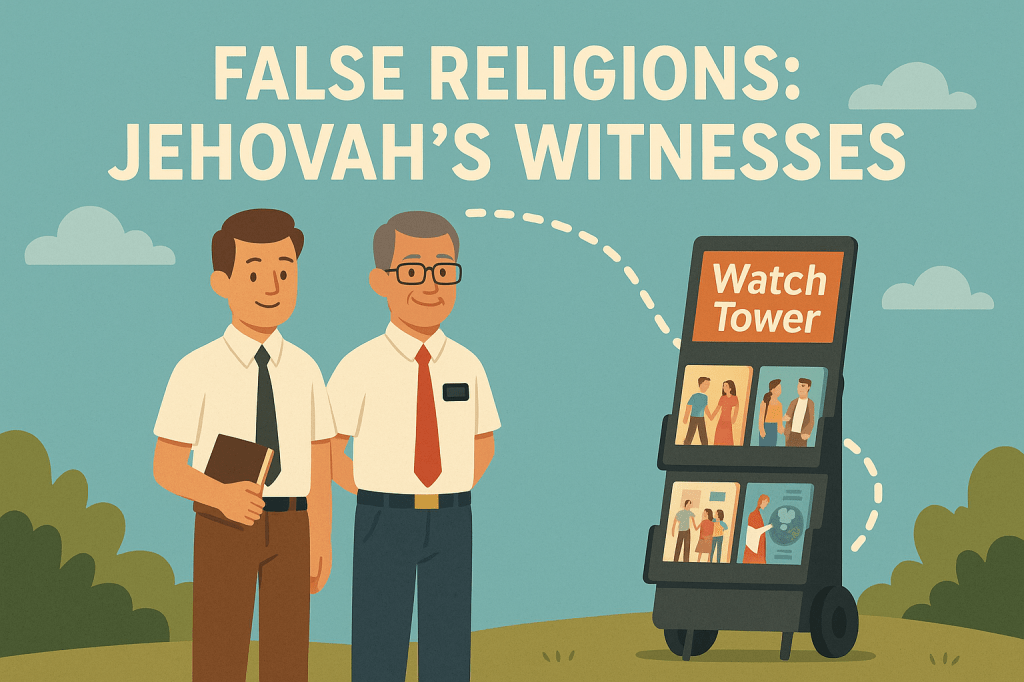
Jehovah’s Witnesses, with over 9 million members worldwide, represent one of the largest and most distinctive religious cults due to their centralized authority and strict social practices. Founded in the late 19th century, their movement is rooted in a questionable interpretation of the Bible, emphasizing door-to-door evangelism and an apocalyptic worldview. This article explores the origins of Jehovah’s Witnesses, their core beliefs, how they differ from orthodox Christianity, and strategies for engaging them in meaningful dialogue using Scripture.
Foundation and Historical Context
The Jehovah’s Witnesses movement began in the 1870s under Charles Taze Russell, a Pittsburgh native who rejected his Presbyterian upbringing as a teenager, questioning traditional Christian doctrines such as the Trinity and eternal punishment. At 18, Russell started a Bible study group known as the Bible Students, where he developed and shared his theological views. In 1879, he launched Zion’s Watch Tower and Herald of Christ’s Presence, a magazine that became a primary vehicle for disseminating his teachings. In 1884, he established the Watch Tower Bible and Tract Society, formalizing his movement. Initially called “Russelites,” his followers adopted the name “Jehovah’s Witnesses” in 1931 under the leadership of Joseph Franklin Rutherford, who succeeded Russell after his death in 1916. Rutherford centralized authority and distinguished the group from other Bible Student factions.
Russell’s theology was heavily influenced by the Adventist movement, particularly its focus on Christ’s imminent return. He made several failed predictions about the Second Coming, including dates in the 1870s and 1914, which later evolved into the belief that Christ returned invisibly to establish God’s Kingdom. The organization, now governed by a small group known as the Governing Body, relocated its headquarters from Brooklyn to Warwick, New York, in 2016. This central authority enforces doctrinal uniformity and directs global evangelistic efforts, a hallmark of the Witnesses’ identity.
Core Beliefs of Jehovah’s Witnesses
Jehovah’s Witnesses hold a distinct set of beliefs, primarily based on their New World Translation (NWT) of the Bible, first published in 1950. Below is an overview of their major theological positions and how they contrast with orthodox Christianity.
Monotheism and Rejection of the Trinity
Jehovah’s Witnesses are strict monotheists, believing Jehovah is the sole true God, rejecting the Christian doctrine of the Trinity. They view Jesus as a created being—specifically the archangel Michael—and the Holy Spirit as an impersonal “active force” akin to energy, not a divine person. This is supported by their interpretation of passages like Acts 2:4, where the Spirit “fills” believers.
Christian Difference: Orthodox Christianity affirms the Trinity: one God in three coequal, coeternal persons (Father, Son, Holy Spirit), as seen in Matthew 28:19 and 2 Corinthians 13:14. Scriptures like John 1:1 (“the Word was God”) and Colossians 2:9 (“in Christ all the fullness of the deity dwells bodily”) confirm Jesus’ divinity, while Acts 13:2 and Romans 8:26 portray the Holy Spirit as a person with attributes like speaking and interceding, contradicting the Witnesses’ view.
Jesus Christ
Witnesses teach that Jesus is not God but the created archangel Michael, who became human and, after his death, resumed his angelic identity as a spirit being. They assert Jesus died on a “torture stake” (a single pole), not a cross, citing the Greek term stauros (Matthew 27:32) and rejecting the cross as a pagan symbol. They also believe Jesus’ resurrection was spiritual, not physical, with his body either dissolved or preserved by Jehovah.
Christian Difference: Christianity upholds Jesus as fully God and fully man, eternally existent (John 1:1; Hebrews 1:8). Historical and biblical evidence supports crucifixion on a cross, a common Roman practice, as described in early Christian writings and John 20:27 (Thomas touching Jesus’ wounds). Luke 24:39 confirms Jesus’ physical resurrection, as he declares, “for a spirit does not have flesh and bones as you see that I have.”
Salvation
Salvation for Witnesses requires faith in Jehovah, strict adherence to Watch Tower teachings, and active participation in door-to-door evangelism. They believe only 144,000 “anointed” Witnesses will rule in heaven with Christ (Revelation 7:4), while the “great crowd” will live eternally on paradise earth (Revelation 7:9).
Christian Difference: Christianity teaches salvation by grace through faith alone (Ephesians 2:8-9; Romans 3:28), with Christ’s sacrifice sufficient for all believers (Hebrews 10:14). The Bible describes an uncountable multitude in heaven (Revelation 7:9), not a limited 144,000, and salvation is not contingent on works or organizational loyalty.
Eschatology
Witnesses anticipate an imminent Armageddon, where only faithful Witnesses will survive, and non-believers face annihilation, not eternal torment. The dead remain unconscious until a future resurrection, with the righteous living on earth or, for the 144,000, in heaven.
Christian Difference: Christianity teaches eternal life for believers and eternal punishment for the unrighteous (Matthew 25:46). Passages like Luke 16:23 and Mark 9:43-48 describe conscious torment, contradicting annihilationism. Luke 23:43 and Philippians 1:23 affirm immediate presence with God after death, not soul sleep.
Scripture
Witnesses use the New World Translation, which has been criticized for alterations supporting their theology, such as rendering John 1:1 as “the Word was a god” and inserting “Jehovah” into the New Testament. The Governing Body’s interpretations are binding, elevating their authority above Scripture.
Christian Difference: Christianity adheres to sola scriptura, with Scripture as the sole infallible authority (2 Timothy 3:16-17). Believers are encouraged to test teachings against original manuscripts (Acts 17:11), unlike the Witnesses’ reliance on the Governing Body.
Practices
Witnesses worship in Kingdom Halls, emphasizing structured Bible study and evangelism training. Door-to-door preaching is mandatory, tied to salvation. Disfellowshipping and shunning enforce conformity, even among family. They refuse blood transfusions (Acts 15:29), abstain from political involvement, and discourage higher education.
Christian Difference: Christian worship includes preaching, sacraments, and community (Colossians 3:16). Evangelism is expected but not a salvation requirement (Matthew 28:19-20). Church discipline aims for restoration (Galatians 6:1), and medical decisions, including transfusions, are matters of conscience. Christians engage in civic life (Romans 13:1-7) and value education (Proverbs 4:7).
Engaging Jehovah’s Witnesses with Scripture
Engaging Witnesses requires a thoughtful, respectful approach, as they are trained to defend their beliefs and may fear questioning due to shunning. Here are strategies and key Scriptures to use, preferably from the New World Translation (accessible at JW.org) to align with their framework:
- Build Trust: Show kindness and respect (1 Peter 3:15), acknowledging their dedication while gently challenging beliefs.
- Ask Questions: Encourage critical thinking with questions (Proverbs 18:17).
- Use Their Bible: Use the NWT when possible because they do not trust any outside sources.
- Focus on Key Issues:
- Deity of Christ: Use Psalm 102:25-27 (NWT) to establish Jehovah’s eternality, then Hebrews 1:10-12 (NWT), which applies the same text to Jesus. Isaiah 9:6 and 10:21 use “Mighty God” for both Jesus and Jehovah. John 20:28 and Revelation 1:7-8 further affirm Jesus’ divinity.
- Salvation by Grace: Highlight Ephesians 2:8-9 and Romans 5:1, asking why salvation depends on works.
- The Trinity: Point to Matthew 28:19 and 2 Corinthians 13:14 for equality among Father, Son, and Holy Spirit.
- Eternal Judgment: Use Matthew 25:46 and Revelation 20:10 to challenge annihilationism.
- Scriptural Authority: Cite 2 Timothy 3:16-17 and Acts 17:11 to question the Governing Body’s supremacy.
- Be Patient & Follow Up: Conversions may take time due to indoctrination and fear of shunning (2 Timothy 2:24-25).
- Pray: Seek the Holy Spirit’s guidance to open their hearts (John 16:8).
Conclusion
Jehovah’s Witnesses are a dedicated group with a distinct theological framework that sets them apart from orthodox Christianity. Their origins in Russell’s rejection of traditional doctrines and their reliance on the Watch Tower Society shape their beliefs and practices. While their commitment to evangelism and moral living is notable, their teachings on the Trinity, salvation, and Scripture diverge significantly from biblical Christianity.
Engaging them requires patience, respect, and a strategic use of Scripture to point them toward the gospel of grace. By understanding their beliefs and approaching them with love, Christians can foster meaningful conversations that encourage Witnesses to reconsider their faith in light of biblical truth.
 Tethered to Truth