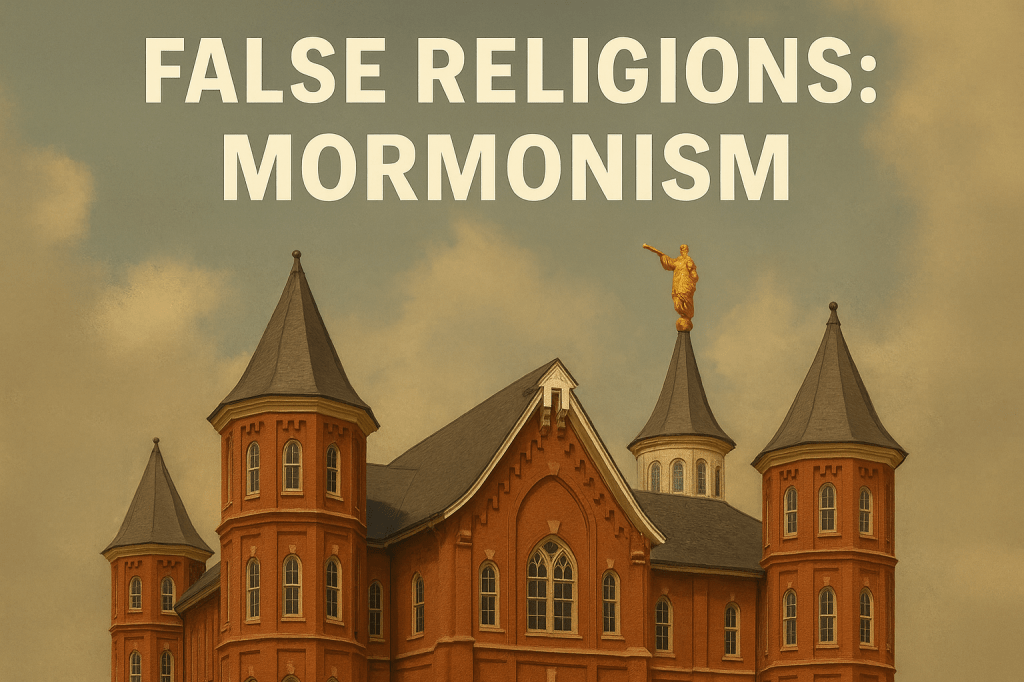
Over the next few weeks we’re going to examine belief systems that deviate from biblical Christianity, starting with the Church of Jesus Christ of Latter-day Saints (LDS), commonly known as Mormonism. With over 17 million members worldwide as of 2024, the LDS Church is one of the largest religious cults globally. While Mormons use Christian language, their core doctrines fundamentally contradict biblical truth. This article explores Mormonism’s origins, key beliefs, and how Christians can lovingly engage Mormons with the gospel, grounded in Scripture’s authority.
Historical Context and Foundation
Mormonism emerged during the Second Great Awakening in the early 1800s, a time of religious fervor in America when many sought the “true” church amid competing denominations. Joseph Smith Jr. (1805–1844) founded the Church of Christ, later renamed the Church of Jesus Christ of Latter-day Saints, on April 6, 1830, in Fayette, New York.
At age 14, Smith claimed a “First Vision” in 1820, where God the Father and Jesus Christ allegedly appeared, declaring all churches corrupt. In 1823, an angel named Moroni supposedly guided him to golden plates buried near Palmyra, New York, written in “Reformed Egyptian.” Using seer stones, Smith translated these plates into the Book of Mormon, published in 1830, which Mormons consider scripture alongside the Bible. Smith also claimed John the Baptist ordained him to restore the “true” church.
The early LDS Church faced persecution for beliefs like polygamy (practiced until 1890), leading to migrations to Ohio, Missouri, and Illinois. In 1844, Smith was killed by a mob in Illinois after arrests for treason and polygamy. Brigham Young led most Mormons to Utah, establishing Salt Lake City as their headquarters.
From a Christian perspective, Mormonism’s origins are problematic. Smith’s visions and the Book of Mormon lack historical or archaeological support, and his claim of restoring a “lost” gospel contradicts the Bible’s sufficiency (2 Timothy 3:16-17; Hebrews 1:1-2). Deuteronomy 18:20-22 labels prophets with unfulfilled predictions, like Smith’s failed prophecies about Jesus’ return by 1891 or a Missouri temple, as false.
Major Mormon Beliefs and Christian Contrasts
Mormon theology blends Christian terms with unique doctrines from Smith’s revelations, diverging significantly from biblical Christianity. Below are key beliefs and their contrasts with Christian doctrine:
The Nature of God
Mormon Belief: The Godhead comprises three separate beings—God the Father, Jesus Christ, and the Holy Ghost—united in purpose but not essence. God the Father was once a mortal man who progressed to godhood, as Joseph Smith stated: “God himself was once as we are now and is an exalted man.” Humans are His literal spirit children, with potential to become gods.
Christian Difference: The Bible teaches the Trinity—one God in three persons, co-equal and co-eternal (Deuteronomy 6:4; Matthew 28:19; 2 Corinthians 13:14). God is eternal, not a former mortal (Psalm 90:2; Isaiah 43:10). Mormonism’s view introduces polytheism, contradicting God’s unique sovereignty.
Salvation
Mormon Belief: Salvation involves faith, repentance, baptism, receiving the Holy Ghost, and enduring in obedience. “Exaltation” to the Celestial Kingdom, the highest heaven, requires works and temple ordinances (2 Nephi 25:23: “It is by grace that we are saved, after all we can do”).
Christian Difference: Salvation is by grace through faith alone (Ephesians 2:8-9; Romans 3:23-24). Works result from salvation, not earn it (Titus 3:5). Mormonism’s works-based exaltation undermines Christ’s sufficient atonement.
Scripture and Revelation
Mormon Belief: Mormons accept four scriptures: the Bible (King James Version, “insofar as it is translated correctly”), Book of Mormon, Doctrine and Covenants, and Pearl of Great Price. The Book of Mormon recounts Jews (Nephites and Lamanites) in ancient America, with Jesus appearing there. Ongoing revelation through LDS presidents continues to shape doctrine.
Christian Difference: The Bible is the sole, sufficient Word of God (2 Timothy 3:16-17; Hebrews 1:1-2). The canon is closed, and new scriptures or prophets contradict its finality (Revelation 22:18-19). The Book of Mormon lacks historical or archaeological evidence.
Jesus Christ
Mormon Belief: Jesus is a created being, the spirit brother of Satan, and not co-equal with the Father. Former LDS President, Joseph Fielding Smith claimed Jesus progressed to fullness, not being perfect initially.
Christian Difference: Jesus is the eternal Son of God, fully divine and human, co-equal with the Father (John 1:1-14; Colossians 1:15-20; Philippians 2:5-11). Mormonism’s view diminishes Christ’s deity and eternal nature.
Eternal Progression
Mormon Belief: Humans existed as spirit children in a pre-mortal state, gain physical bodies on earth, and progress to one of three heavens (Telestial, Terrestrial, Celestial) or Outer Darkness. Faithful Mormons can achieve godhood, as Lorenzo Snow said: “As man now is, God once was; as God now is, man may be.”
Christian Difference: Humans are created, not pre-existent, and salvation means eternal communion with God, not becoming gods (Isaiah 43:10; Revelation 21:3-4). This polytheistic doctrine contradicts biblical monotheism.
Baptism for the Dead
Mormon Belief: Proxy baptisms in temples allow deceased individuals to accept the gospel after death, based on 1 Corinthians 15:29.
Christian Difference: Hebrews 9:27 states, “It is appointed for man to die once, and after that comes judgment.” Baptism for the dead lacks biblical support and contradicts salvation through faith in this life.
Word of Wisdom
Mormon Belief: A health code from Doctrine and Covenants 89 prohibits alcohol, tobacco, coffee, tea, and drugs, with eternal consequences for non-compliance.
Christian Difference: The Bible condemns drunkenness but imposes no dietary code (1 Timothy 3:8). Christian liberty allows moderation, emphasizing sober-mindedness.
Polygamy
Mormon Belief: Practiced until 1890, polygamy was endorsed by Smith (27 wives) and Young (25 wives). Some fundamentalist groups continue it.
Christian Difference: Biblical marriage is monogamous—one man, one woman for life (Matthew 19:4-6; 1 Timothy 3:2). Polygamy contradicts God’s design.
Engaging and Evangelizing Mormons
Sharing the gospel with Mormons requires love, truth, and respect, recognizing their sincerity while addressing doctrinal errors. Here are practical strategies:
- Build Relationships: Engage with kindness, asking about their faith to build trust. Avoid confrontation, as Mormons are trained to defend their beliefs.
- Use Scripture: Since Mormons respect the Bible, use the King James Version to discuss:
- Trinity: Deuteronomy 6:4; John 10:30; 2 Corinthians 13:14.
- Salvation by Grace: Ephesians 2:8-9; Romans 3:23-24.
- Christ’s Deity: John 1:1-14; Colossians 1:15-20.
- Scripture’s Sufficiency: 2 Timothy 3:16-17; Hebrews 1:1-2.
- Highlight Christ’s Sufficiency: Emphasize Jesus as the eternal Son, the only mediator (1 Timothy 2:5; Hebrews 7:25).
- Ask Questions: Encourage reflection with, “How does the idea of multiple gods align with Isaiah 43:10?” or “Why are works required for exaltation if grace saves?”
- Address False Prophecies: Point to Smith’s unfulfilled predictions (e.g., Jesus’ return by 1891) using Deuteronomy 18:20-22 to show his unreliability.
- Invite to Community: Welcome Mormons to church or Bible studies to experience biblical Christianity.
- Pray: Seek the Holy Spirit’s guidance, trusting God for conversions (1 Peter 3:15-16).
Living Out the Truth
Mormonism, while using Christian terms, diverges from biblical truth in its view of God, salvation, scripture, and Christ. We must approach Mormons with love, grounded in Scripture’s authority, sharing the true gospel of grace through faith in the sufficient Savior, Jesus Christ. Trust the Holy Spirit to open hearts, confident that God’s truth always prevails.
 Tethered to Truth