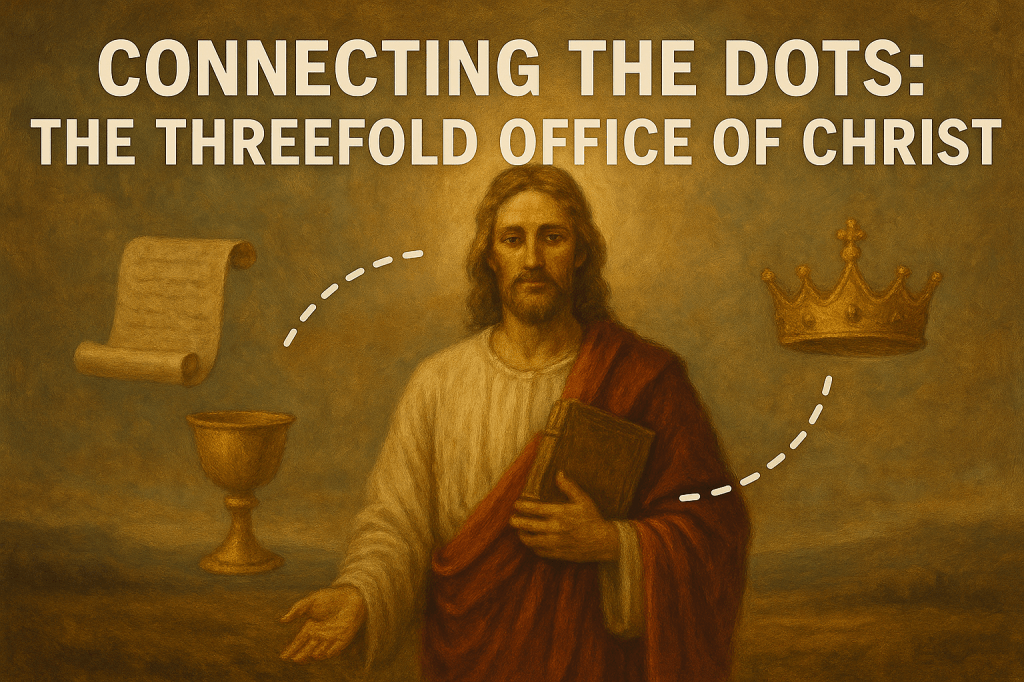
In this article in our “Connecting the Dots” series, we are looking at the threefold office of Christ—His role as Prophet, Priest, and King. This doctrine unveils Jesus as the Messiah, the Anointed One, who perfectly fulfills and unites these Old Testament offices, revealing God’s truth, atoning for our sins, and reigning over all creation. Understanding Christ’s threefold office transforms how we trust, worship, and follow Him.
Hebrews 1:1-3 sets the stage: “Long ago, at many times and in many ways, God spoke to our fathers by the prophets, but in these last days he has spoken to us by his Son, whom he appointed the heir of all things, through whom also he created the world. He is the radiance of the glory of God and the exact imprint of his nature, and he upholds the universe by the word of his power. After making purification for sins, he sat down at the right hand of the Majesty on high.”
Jesus is the ultimate revelation of God, the final sacrifice for sin, and the sovereign King. In the Old Testament, God appointed prophets, priests, and kings—imperfect figures anointed with oil to serve His people. Jesus, the Messiah or Christ (meaning “Anointed One”), perfectly embodies all three, fulfilling God’s redemptive plan.
Old Testament Typology and the Messiah
The Old Testament uses “types”—people, events, or objects that foreshadow New Testament realities. For example, Noah’s ark prefigures baptism (1 Peter 3:21), Jonah’s three days in the fish point to Jesus’ burial (Matthew 12:40), and the Passover lamb’s blood (Exodus 12) symbolizes Christ’s atoning blood (1 Corinthians 5:7). Similarly, the offices of prophet, priest, and king foreshadow Jesus. Prophets like Moses and Isaiah spoke God’s word; priests like Aaron mediated for the people; kings like David ruled as God’s representatives. Each was anointed, as seen with Elisha (1 Kings 19:16), Aaron (Exodus 29:7), and David (1 Samuel 16:13). Yet, their imperfections—some righteous, others wicked—pointed to a greater Anointed One. Jesus, the Messiah, perfectly unites these roles, fulfilling God’s promise of a deliverer.
Jesus as the Perfect Prophet
Jesus not only speaks God’s words but is the Word of God. Old Testament prophets, like Moses or Elijah, declared, “Thus says the Lord,” delivering messages of truth, warning, or Messianic hope. God promised a greater prophet in Deuteronomy 18:18: “I will raise up for them a prophet like you… and he shall speak to them all that I command him.” In the New Testament, Jesus fulfills this. The woman at the well called Him a prophet (John 4:19), as did the healed blind man (John 9:17). Hebrews 1:1-2 confirms, “God… has spoken to us by his Son.”
Unlike other prophets, Jesus doesn’t merely relay God’s words; He is “the Word” (John 1:1), the “radiance of the glory of God” (Hebrews 1:3). At the Sermon on the Mount, He declared, “You have heard it said, but I say to you,” teaching with divine authority (Matthew 5:21-22). Jesus reveals God Himself, saying, “Whoever has seen me has seen the Father” (John 14:9). As the object of all prophecy, He fulfills the Old Testament’s promises, guiding us to truth.
Jesus as the Perfect Priest
Jesus not only offers a sacrifice but is the sacrifice for His people. Old Testament priests, like Aaron, mediated between God and Israel, offering sacrifices for sin. Yet, these sacrifices couldn’t remove guilt, serving as a reminder of sin (Hebrews 10:4). Psalm 110:4 prophesied a greater priest: “You are a priest forever after the order of Melchizedek.” Unlike Levitical priests, who offered repeated sacrifices and atoned for their own sins, Jesus, sinless, offered Himself once for all.
Hebrews 10:11-12 contrasts, “And every priest stands daily at his service, offering repeatedly the same sacrifices, which can never take away sins. But when Christ had offered for all time a single sacrifice for sins, he sat down at the right hand of God.” Hebrews 1:3 affirms He “made purification for sins.” As the “one mediator between God and men” (1 Timothy 2:5), Jesus atones for our sins and intercedes for us, saving “to the uttermost those who draw near to God through him” (Hebrews 7:25). His priesthood is eternal, offering forgiveness and access to God.
Jesus as the Perfect King
Jesus not only has kingly authority but is the ultimate King. Old Testament kings, like Saul and David, ruled as God’s representatives, executing justice. Some were godly; others failed. Psalm 89:35-36 promised a Davidic king whose “throne shall endure forever.” Psalm 110:1 adds, “The Lord says to my Lord, ‘Sit at my right hand,’” pointing to the Messiah’s eternal reign.
The New Testament heralds Jesus’ kingship: the Magi sought the “King of the Jews” (Matthew 2:2), His triumphal entry fulfilled royal prophecy (Zechariah 9:9), and His crucifixion sign read, “Jesus, the King of the Jews” (Matthew 27:37). Revelation 17:14 crowns Him “King of kings and Lord of lords.” Jesus rules not only Israel but the cosmos, with all authority under His command (Philippians 2:9-10). His kingdom is eternal, and we live under His sovereign reign.
Living in Light of Christ’s Threefold Office
Jesus’ fulfillment of these offices shapes our faith and practice:
Trust His Word as Prophet
As the perfect Prophet, Jesus’ words are divine truth. Neglecting Scripture stunts our spiritual growth and distance us from God. Psalm 1:2-3 likens those who meditate on God’s law to trees bearing fruit. 2 Timothy 3:16 declares, “All Scripture is breathed out by God and profitable for teaching.” To grow closer to God, we must read His Word daily. Start with a reading plan, like the Gospels, and let Jesus’ teachings transform your life, which is sharper than any sword (Hebrews 4:12).
Run to Him as Priest
As our High Priest, Jesus sympathizes with our weaknesses, having been tempted yet sinless (Hebrews 4:15). He atoned for our sins and intercedes for us. Struggling with sin? Run to Jesus, the bread of life (John 6:35). Lonely? He’s the friend of sinners (Luke 7:34). Heartbroken? He comforts the broken (Psalm 34:18). Hebrews 4:16 urges, “Draw near to the throne of grace with confidence… and find mercy.” Trust His sacrifice and intercession for every need.
Submit to His Kingship
As King, Jesus reigns over all creation. Nothing escapes His sovereign will, giving us confidence in His control. Philippians 2:10-11 declares every knee will bow to Him. For non-believers, this means submitting to Christ now, trusting His sacrifice to escape judgment. For believers, it means living as kingdom citizens, worshipping in spirit and truth (John 4:24), following His direction, and surrendering to His lordship. His resurrection crushed sin and death, securing our hope.
The Anointed One Our Hope
Jesus, the Messiah, perfectly unites the offices of Prophet, Priest, and King, revealing God’s truth, atoning for our sins, and reigning forever. So let’s trust His Word, run to His grace, and submit to His rule, finding all hope in the Anointed One who saves and sustains us.
 Tethered to Truth